How to Get a 5 on the AP Human Geography Exam: Proven Strategies & Study Plan

Getting a 5 on the AP Human Geography exam, you’ll need more than just simple memorization. You should focus on high-valued units, mastering the vocabulary, and getting comfortable with analyzing maps and data quickly.
Practice with past questions, under timed conditions, so you can have testing speed and confidence under pressure.
Key Takeaways
- Zero in on the most heavily tested units and clear vocab.
- Simulate exam conditions with timed practice and full-length tests.
- Fix weak spots by reviewing scored samples and targeting errors.
Understanding the AP Human Geography Exam
You should think about timing, knowing the task, and understanding how graders think if you want a 5 on the AP Human Geography exam.
Exam Structure and Format
The AP Human Geography exam takes about 2 hours and 15 minutes and runs on the Bluebook app. There are two sections: 60 multiple-choice questions in 60 minutes and three FRQs in 75 minutes. Each section counts for half the score.
Content covers population, migration, culture, agriculture, industry, and cities. Expect to interpret maps, graphs, and small data sets. Practicing in Bluebook’s interface will save you time on test day.
- 60 MCQs, 3 FRQs
- Digital Bluebook app
- 50% MCQ, 50% FRQ
- Practice navigation ahead of time
| Section | Questions | Timing | Weight |
|---|---|---|---|
| MCQ | 60 | 60 min | 50% |
| FRQ | 3 | 75 min | 50% |
Multiple-Choice vs. Free-Response Sections
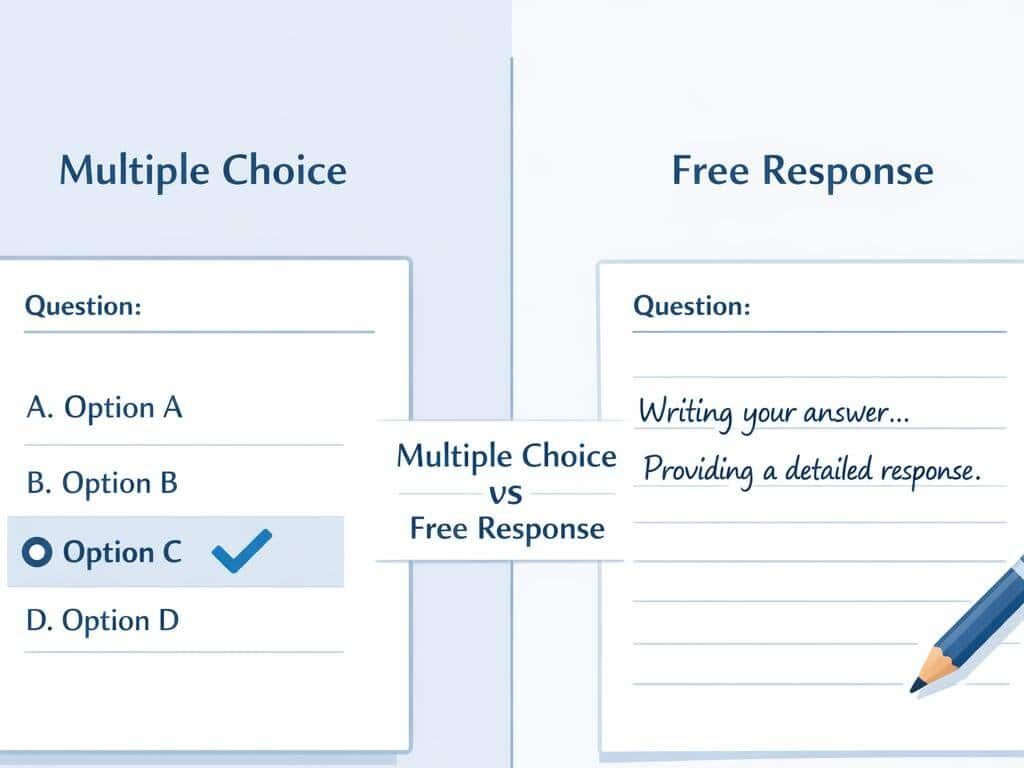
MCQs check if you can spot relationships and patterns. You’ll see maps, models, and diagrams—one question per minute, so don’t linger. Eliminate obvious wrong answers before picking the most specific one.
FRQs want you to explain, analyze, and use terms in real-world examples. Each has parts A, B, and C. Restate the prompt, answer directly, and support with a real country or city. Use precise vocab like “diffusion” or “primate city.” Bullets are fine if they’re clear and labeled. When you practice, try to spend about 25 minutes per FRQ.
- MCQ: One per minute, use process of elimination
- FRQ: Direct, example-based, use AP vocab
- Bullets okay if clear
- Time yourself on practice
Scoring Guidelines and What It Takes to Score a 5
Your raw MCQ and FRQ points get combined and converted to the 1–5 scale. The College Board’s rubrics and samples show what earns points. To snag a 5 on the AP Human Geography exam, you need consistent, correct application and terminology in both sections.
Match your FRQ responses to rubric language. For MCQs, accuracy and pacing matter—miss a few, but ace the FRQs, and you can still get a 5. Check AP Central for scoring guides and practice writing rubric-matching responses.
- Composite score = MCQ + FRQ
- Rubrics are key
- Consistency and vocab earn points
- Practice with real samples
| What Graders Want | How to Practice |
|---|---|
| Rubric-matching answers | Write to rubric, check samples |
| Precise vocab | Drill terms, use in context |
| Clear examples | Always name a place |
Mastering Core Units and Key Concepts
Getting a 5 on the AP Human Geography exam means you can connect places, people, and culture together. You’ll need to know the models, maps, and terms, and be able to explain them deeply.
Thinking Geographically and Spatial Relationships
Reading maps and data lets you explain why things happen in certain places. Practice with coordinate systems, scale, and projection types. Learn to measure distance, direction, and connectivity using examples like the gravity model for trade or Tobler’s Law for spatial interaction.
Interpret GIS outputs and choropleth maps. Spot clustering, dispersion, or linear settlements. Use spatial analysis to link rivers to transport or elevation to settlement density. Memorize terms like site, situation, hearth, network, and scale. Try comparing two places using spatial relationships and causal links in short answers.
- Map reading matters
- Know spatial vocab
- Practice short, comparative answers
- Use real-world examples
Population and Migration Patterns and Processes
Population changes and migration patterns are huge for a 5 on the AP Human Geography exam. Learn the Demographic Transition Model stages and connect them to birth/death rates and economic conditions. You should be able to read population pyramids and spot trends.
Understand voluntary vs. forced migration, internal vs. international, and terms like step and chain migration. Push and pull factors?
Think jobs, conflict, disasters, or policy. Practice applying demographic tools to case studies—like explaining high out-migration in a Stage 2 country. Short math? Know how to calculate crude birth rate and growth rate if it comes up.
- DTM stages and pyramid reading
- Migration types and factors
- Apply to real countries
- Quick demographic math
| Concept | Example |
|---|---|
| DTM Stage 2 | High birth, rapid growth, out-migration |
| Push factor | Conflict, lack of jobs |
| Pull factor | Better wages, safety |
Cultural Patterns and Diffusion

Culture spreads and shifts—your job is to explain how. Identify traits like language, religion, or food and track their diffusion: relocation, hierarchical, contagious, or stimulus. Use examples like English’s spread or fast food’s global reach.
Analyze cultural landscapes for signs of ethnic neighborhoods or sacred sites. Discuss acculturation and assimilation, especially for migrants.
Know vocab like culture hearth, syncretism, and folk vs. popular culture. Practice short essays comparing diffusion types and predicting cultural change under economic or media influence.
- Diffusion types and vocab
- Use real cultural examples
- Analyze landscapes
- Short comparative essays
Political Organization and Boundaries
Political geography links power to space. Learn the difference between a state and a nation, and what makes a multinational or stateless nation. Study boundary types: geometric, antecedent, subsequent, and consequent—know how they spark conflict or cooperation.
Map political organization at different scales. Explain supranational bodies, federal vs. unitary systems, and territorial integrity. Use real cases like boundary disputes or decolonization.
Memorize sovereignty, gerrymandering, and enclave/exclave. Be ready to show how political choices affect migration and resource access.
- Boundary types and disputes
- State/nation definitions
- Political system comparisons
- Real-world examples
| Term | Meaning |
|---|---|
| Geometric boundary | Straight-line, often colonial |
| Gerrymandering | Manipulating districts for advantage |
| Supranational | EU, UN, etc. |
Addressing Advanced Topics: Agriculture, Urban, and Economic Development
Land, people, and markets all interact here. For a 5 on the AP Human Geography exam, you’ll need to show how location, tech, and policy shape farming and cities.
Agriculture and Rural Land-Use Patterns
Spot the farming system by climate, labor, and market access. Intensive systems (like rice paddies) use small plots and lots of labor. Extensive systems (like ranching) need more land and less input.
Know the Green Revolution: high-yield seeds and fertilizers boosted output but stressed land and water. Use the Von Thünen model to predict crop placement—perishables near cities, grains farther out
Remember land survey types and how they shape settlement. Expect to explain why a region uses a particular agricultural method.
- Intensive vs. extensive agriculture
- Von Thünen model
- Green Revolution pros/cons
- Land survey patterns
Industrial and Economic Development Trends
Industrial location depends on raw materials, labor, capital, and market access. Recognize old clusters (like textiles) and new global supply chains.
Know GDP per capita and HDI, but also informal economies. Rostow’s stages? Use them, but question them—pair with core-periphery and dependency ideas.
Track the shift from primary to tertiary sectors. Outsourcing and special economic zones matter. Be ready to analyze real cases: what attracted industry, spatial effects, and policy impacts on growth. For a 5 on the AP Human Geography exam, tie these trends to actual regions and outcomes.
- Location factors for industry
- Development measures
- Sector shifts
- Outsourcing/globalization
Proven Study Strategies and Resource Recommendations
Consistency wins. Build a schedule, drill vocab, and use top study guides and online tools to spot weak areas and get feedback fast.
Building an Effective Study Plan
Set a plan with specific weekly topics and active tasks. For example: Week 1—Population, read a chapter, make 50 vocab flashcards, do one practice set. Use a calendar app or paper planner to block 45–90 minute sessions, three times a week minimum.
Prioritize the highest-weight AP Human Geography units like population, migration, and politics. Mix in short daily drills on vocab and maps. Every 2–3 weeks, take a full-length practice exam; in the last month, go weekly. If you’re stuck, try a study group or AP tutor to nail tough concepts.
- Block study sessions on your calendar
- Mix review with drills and full tests
- Focus on high-yield units
- Join a study group if needed
| Week | Focus | Task Example |
|---|---|---|
| 1 | Population | 50 vocab flashcards, 1 practice set |
| 2 | Migration | Map drills, FRQ practice |
| 3 | Culture | Model diagrams, compare diffusion |
Choosing the Right Study Resources
Trusted guides like Barron’s or Princeton Review offer solid outlines and review questions. Supplement with free online resources and the official AP course description. These match the skills you’ll need for a 5 on the AP Human Geography exam.
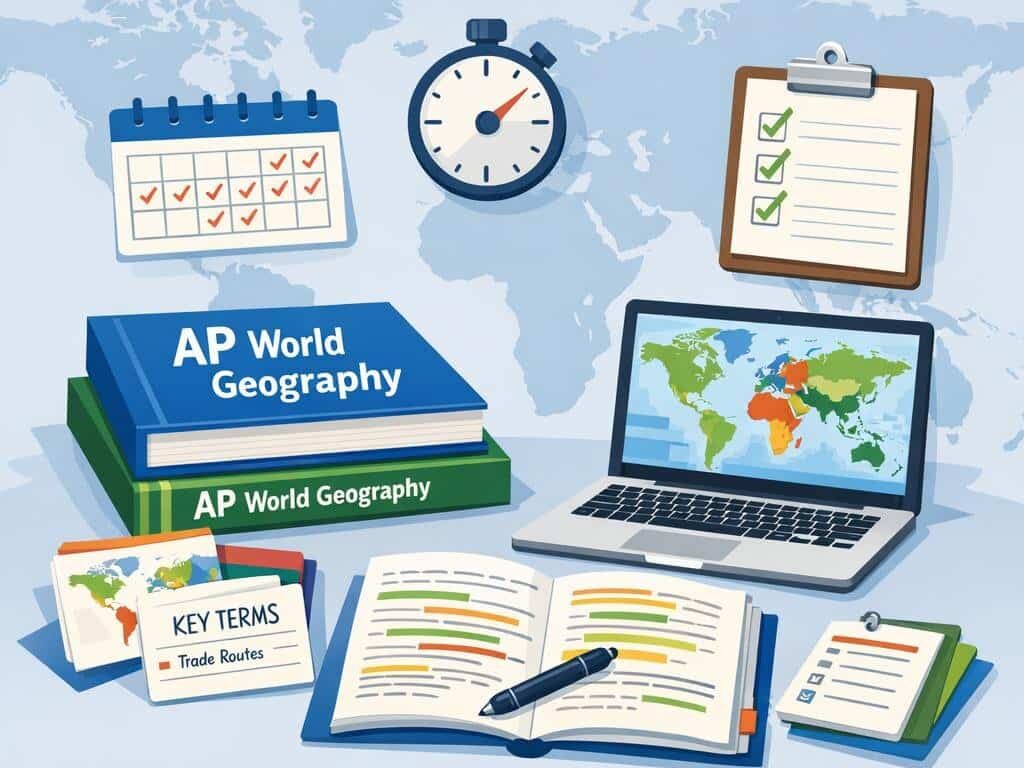
Use digital flashcards, Quizlet sets, and YouTube breakdowns for tricky models or vocab. AP Central’s released FRQs and scoring guidelines are gold for seeing what graders want. Don’t just read—practice writing your own answers and compare them to samples.
- Pick a main review book
- Use digital flashcards for vocab
- Watch YouTube for tough topics
- Practice writing, not just reading
Timed Practice and Self-Assessment
Take practice exams under real conditions. Set a timer, use the Bluebook app if you can, and don’t pause for distractions. Afterward, check every answer—MCQ and FRQ—to see where you lost points.
Track your progress with a simple spreadsheet or notebook. Write down which units or question types trip you up, then focus your next study block there. Getting a 5 on the AP Human Geography exam means you’re honest about your weak spots and fix them, not just hope for the best.
- Simulate real exam timing
- Review every mistake
- Track weak spots
- Adjust your plan as needed
| Practice Tip | Why It Helps |
|---|---|
| Timed MCQ sets | Improves pacing |
| Weekly FRQs | Builds confidence |
| Error log | Targets weak areas |
Utilizing Flashcards, Charts, and Vocabulary Tools
Make flashcards for terms, models, and case studies. Write the term on one side, and on the other, jot the definition, an example, and maybe a rough map or diagram.
Digital flashcard apps like Quizlet are handy—study wherever, create timed drills, and share sets with friends. It’s way easier to get a 5 on the AP Human Geography exam when you have these tools at your fingertips.
Use charts to compare models, like demographic transition versus epidemiological transition. Summarize policies, push/pull factors, or agriculture types on one page and pin it up where you see it daily.

Practice saying definitions out loud. Try using terms in a sentence to make them stick for those tricky free-response questions.
- Flashcards: focus on terms, models, and examples
- Charts: compare models, summarize policies
- Spaced repetition: review weak items more often
- Daily exposure: pin up vocab sheets
Rotate cards using a spaced-repetition system so you hit weak spots more often. Tag flashcards as “know,” “need review,” or “need help.”
Zero in on “need help” cards during group study or tutoring. That’s where you’ll make real progress toward a 5 on the AP Human Geography exam.
Practice Questions, Tests, and Feedback
Mix up multiple-choice sets and free-response practice under timed conditions. Start small to build accuracy, then work up to full practice exams.
After each run, grade it using official rubrics. Note exactly where you slipped up—was it recall, data analysis, or argument writing?
| Practice Focus | Why It Matters |
|---|---|
| Timed sets | Builds speed and accuracy |
| Rubric grading | Targets weak skills |
| Error logs | Identifies patterns |
- Use released AP Human Geography practice exams
- Log mistakes by topic
- Rewrite correct answers and explain errors
- Share essays for feedback
Review each mistake by writing a better answer and explaining why other choices don’t fit. Share essays with a teacher or study group for feedback on thesis, evidence, and spatial thinking.
Keep treating every practice test as a learning tool. Correct it right away, update your study plan, and repeat targeted drills until you’re scoring like someone aiming for a 5 on the AP Human Geography exam.
Mastering Test-Taking Techniques
Test-day nervousness is real, but a few smart habits can make a huge difference. If you want that 5 on the AP Human Geography exam, you’ll need to master them.
Time Management Strategies
Treat the exam like a practice run. For the 60-question multiple-choice section, aim for about 45–50 seconds per question so you have a few minutes to review.
Mark skipped questions with a symbol, then circle back in a final sweep. Break your time into blocks: first pass for easy questions, second for medium, and last for the hardest.
- 45–50 seconds per question for multiple choice
- Mark and return to skipped items
- Block time by question difficulty
- Checklist: time, unanswered count, labels
For free-response, read all prompts first and rank by point value and confidence. Spend more time where you can use direct examples of place, location, or region.
Use the last 5–10 minutes to proofread. Make sure you labeled all maps or tables and answered every part—don’t let silly mistakes cost you that 5 on the AP Human Geography exam.
Answering Multiple-Choice Questions Efficiently
Start by reading the question stem, not the answers. Spot key geographic terms—place, location, movement, or region—before you look at the choices.
Use process of elimination fast. Cross out the worst two answers, then decide between the rest.
| Step | Reason |
|---|---|
| Read stem first | Focuses your attention |
| Eliminate obvious errors | Increases odds on guesses |
| Check maps/charts | Details often matter |
- Don’t overthink—your first instinct is often right
- Note orientation, scale, and legend on visuals
- Answer every question—no penalty for guessing
If a map or data chart pops up, check orientation and legend first. These tiny details can make or break your answer.
If time’s running low, fill in every bubble. There’s no penalty for guessing, so don’t leave anything blank if you want a 5 on the AP Human Geography exam.
Excelling on Free-Response Questions

Plan each response quickly: jot a one-sentence thesis, list 2–3 concrete examples, and pick a geographic model or theory you’ll mention.
Use specific examples—places, migration flows, demographic models—to grab points. Label all maps and figures, and sketch diagrams if they help.
- Quick plan: thesis + examples + model
- Label all visuals
- Use geographic vocabulary
- Show cause-and-effect, not just facts
Write in short, clear paragraphs. Use bullets for multi-part answers and label each section (a), (b), (c) if the prompt asks.
Leave a couple of minutes to double-check that you answered every bullet and used precise examples—countries, dates, migration routes. That’s what separates a 5 on the AP Human Geography exam from the rest.
Leveraging Visuals: Maps, Models, and Data Sources
When you see a map, check the directions, scale, and legend straight away. Link features to concepts like place or movement and jot a quick caption to anchor your answer.
For models or graphs, spot the axes and what each curve represents. Say which model applies—demographic transition, von Thünen, whatever fits—and use real data points or regions to explain differences.
- Check map details first
- Label axes and trends for models
- Refer to exact data in answers
- Practice with different map and chart types
Cite specific numbers from data tables—percentages, years, whatever you’ve got. Practice reading all kinds of visuals so you can convert them into sharp evidence for your 5 on the AP Human Geography exam.
Managing Stress and Final Exam Readiness
To be able to get a 5 on the AP Human Geography exam, focus on relaxation, group review, and a steady routine.
Relaxation and Mindfulness Techniques
Take a deep breath before you study and on test day. Try 4-4-6 breathing: inhale for 4 seconds, hold 4, exhale 6. Repeat three times to slow your heart and steady your focus.
Practice a two-minute body scan. Sit quietly, notice tension from your head to your toes, and let each part relax before moving on.
- 4-4-6 breathing for calm
- Body scan to release tension
- Visualization for confidence
- Mindfulness breaks to reset focus
Visualize yourself walking into the exam room, finding your seat, and confidently writing a free-response answer. Even two minutes of this can help.
Try a short mindfulness break: set a 5-minute timer, close your eyes, and just notice your breath. Use an app or YouTube clip if you need structure.
Keep relaxation tools close—maybe a cue card for breathing, a script for visualization, and a playlist of mellow tracks. Use them in the hour before the big test.
Reviewing with Study Groups and AP Tutoring

Form a small study group—2 to 4 people works best. Assign each person a topic like population, cultural patterns, or political geography, and teach it for 10 minutes.
Teaching helps you recall and spot weak spots. Swap old FRQ prompts and practice timed answers, then trade feedback with a quick rubric check.
| Group Activity | Benefit |
|---|---|
| Teach a topic | Reveals knowledge gaps |
| Swap FRQs | Practice under pressure |
| Peer feedback | Sharpens evidence and structure |
- AP tutoring for targeted help
- Model FRQ answers and map skills
- YouTube lessons for quick refreshers
- Shared study guides for core models and case studies
Use AP tutoring for your toughest units—pick a tutor who walks through model FRQs and maps concepts to real-world examples. Combine that with short YouTube lessons for a quick review.
Create a shared study guide. Add a chart of core models and a page of high-yield case studies with dates and regions. Update it after every group session to keep things fresh for your 5 on the AP Human Geography exam.
Final Review and Exam Day Checklist
Take a deep breath—final review matters. In the last 48 hours, focus on one solid pass through high-yield models. Set a timer and do one timed practice MCQ set. Then knock out a timed FRQ, no distractions. Keep each session to about 45 minutes.

Seriously, don’t push it—burnout sneaks up fast. In between, get up and move. A ten-minute walk or just a few slow breaths can reset your mind. Pack your exam bag the night before.
Toss in your admission ticket, photo ID, two sharp pencils, eraser, and an approved calculator if you’re allowed one. Don’t forget water and a simple snack—nothing that’ll upset your stomach. I always throw in a watch, just in case. On test morning, go for a breakfast with protein and fruit. Skip heavy stuff that’ll slow you down.
Try a five-minute breathing routine. I like to outline one quick FRQ just to wake up my brain. Plan to get there 20–30 minutes early. It’s not worth the stress of running late.
If anxiety hits during your 5 on the ap human geography exam, stop for a second. Breathe in for 4, hold for 4, out for 6. Then scan for an easier question and get some momentum going.
| Checklist Item | Why It Matters |
|---|---|
| 48-hour review | Refreshes high-yield content, builds confidence |
| Pack essentials | Prevents last-minute panic |
| Arrive early | Reduces stress, gives you a buffer |
It’s about setting yourself up to think clearly and stay calm. You’ve put in the work—now it’s about execution. What’s one thing you’ll do differently on your next big exam day?
Conclusion
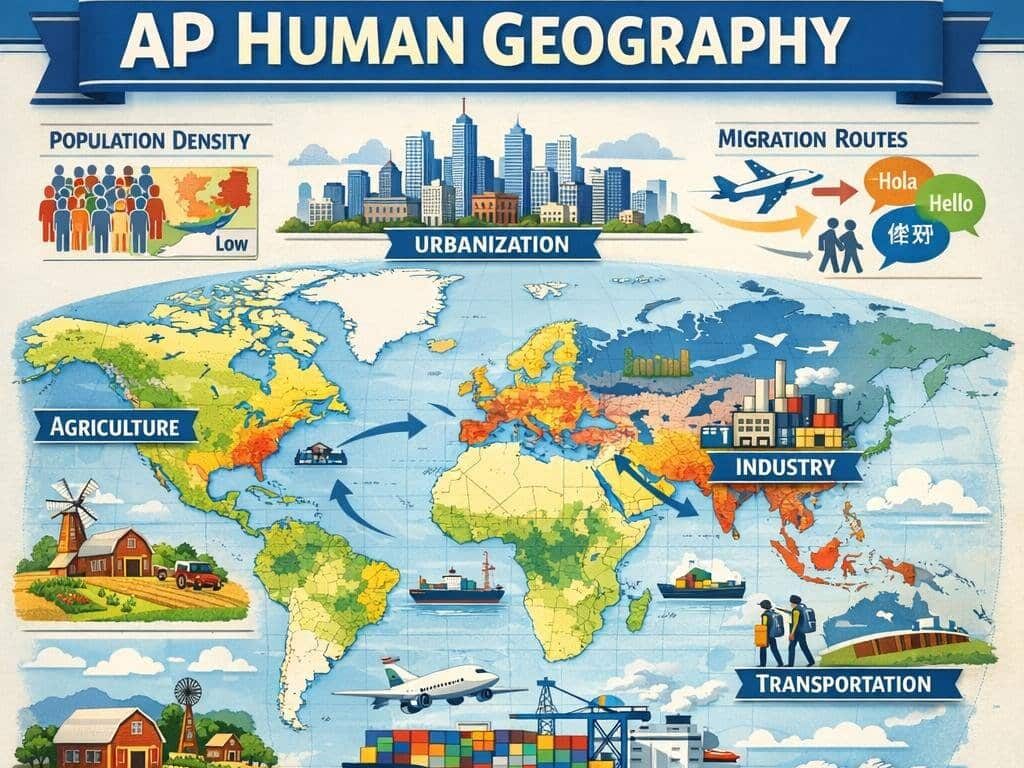
Getting a 5 on the AP Human Geography exam isn’t just about memorization. It’s about practicing smartly, using feedback, and having test-day confidence.
Are you ready to give these strategies a real shot?
References
College Board. “AP Human Geography Exam.” AP Central, College Board, https://apcentral.collegeboard.org/courses/ap-human-geography/exam
College Board. AP® Human Geography Course and Exam Description. AP Central, College Board, https://apcentral.collegeboard.org/media/pdf/ap-human-geography-course-and-exam-description.pdf
College Board. “Free-Response Questions and Scoring Information: AP Human Geography (past exam questions).” AP Central, College Board, https://apcentral.collegeboard.org/courses/ap-human-geography/exam/past-exam-questions
College Board. “What Is Bluebook?” SAT Suite Help Center, College Board, https://satsuite.collegeboard.org/help-center/what-is-bluebook
AP Students. “AP Human Geography — About the Exam.” AP Students, College Board, https://apstudents.collegeboard.org/courses/ap-human-geography/assessment
The Princeton Review. Princeton Review — AP Human Geography Premium Prep (book description and online resources), https://www.penguinrandomhouse.com/books/775623/princeton-review-ap-human-geography-premium-prep-17th-edition-by-the-princeton-review
Barron’s Educational Series. “AP Human Geography Resources.” Barron’s, https://www.barronseduc.com/ap-human-geo-resources
Quizlet. “AP Human Geography Exam Review Flashcards.” Quizlet, https://quizlet.com/23250335/ap-human-geography-exam-review-flash-cards