
4 Learning Styles: Myth or Science? What Research Reveals

Picture this: You’re sitting in a high school classroom, convinced you just “aren’t an auditory learner.” Maybe you doodle in your notebook while the teacher talks on, hoping an illustration will help things click. Sound familiar? So many of us grew up believing we fit neatly into one of those four learning styles—visual, auditory, reading/writing, or kinesthetic.
But here’s the kicker—while the idea feels true, research just doesn’t support it. You’ll actually learn more when teaching and study methods follow proven memory and practice principles, not fixed learning-style labels.
This article digs into where the four-style idea came from, why so many scientists call it a myth, and what practical steps actually boost learning for anyone. You’ll get some clear, usable tips to shake up how you study or teach so your time and effort actually pay off.
Key Takeaways
- The four-style claim lacks strong scientific support.
- Effective learning uses evidence-based methods that work across people.
- Teachers and learners should focus on strategies that improve memory and transfer.
| Learning Style | Typical Preference |
|---|---|
| Visual | Diagrams, charts, spatial layouts |
| Auditory | Lectures, discussions, spoken explanations |
| Read/Write | Lists, written notes, definitions |
| Kinesthetic | Hands-on practice, labs, movement |
The 4 Learning Styles Theory: Origins and Models
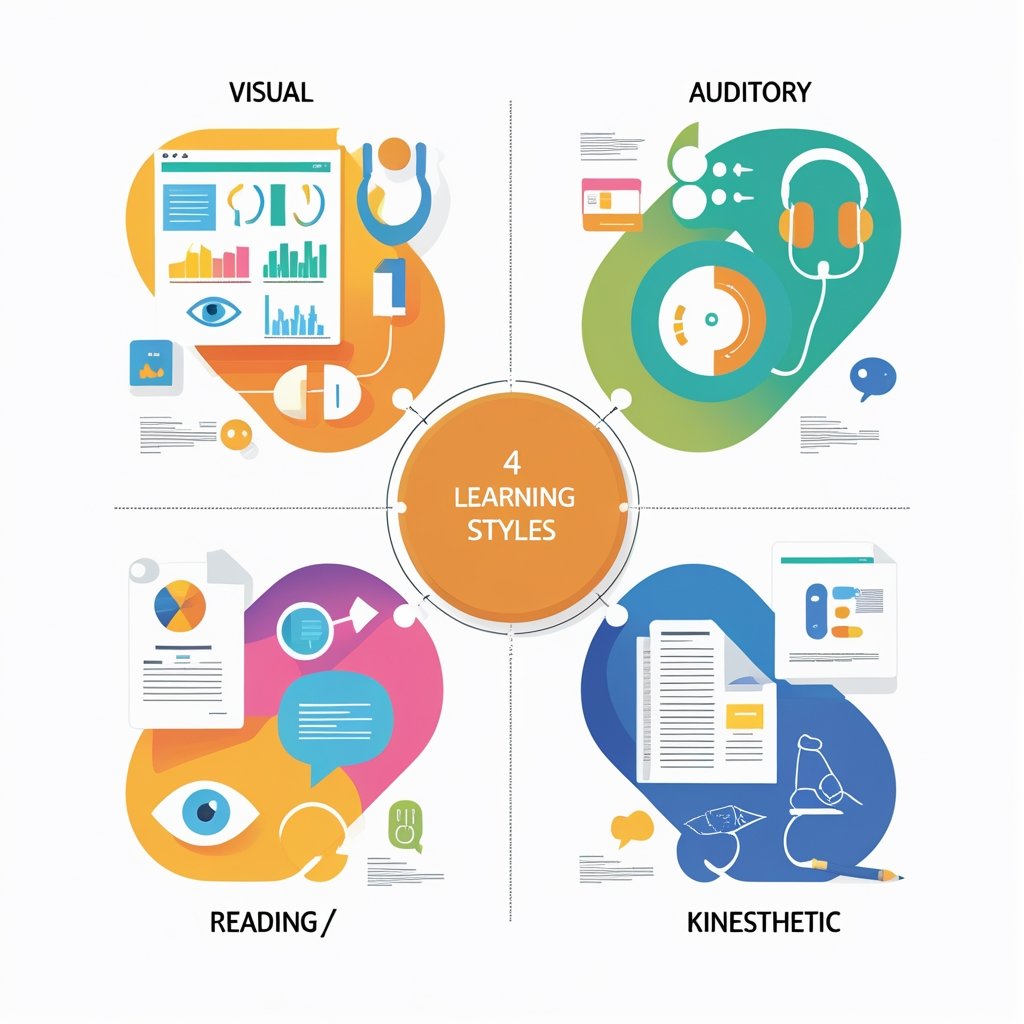
So how did this whole “learning styles” thing even start? Major models tried to classify learners, each with their own preference. The VARK model is probably the one you’ve seen most often.
VARK sorts learners into Visual, Aural, Read/Write, and Kinesthetic categories. It was never meant to be a strict prescription for teaching—just a tool to help students reflect on their study habits. These days, you’ll spot VARK in classrooms everywhere, suggesting things like diagrams for Visual folks or note lists for the Read/Write crowd.
- VARK is the most popular model, but not the only one.
- Kolb’s experiential model uses a four-stage learning cycle.
- Coffield’s review found dozens of frameworks—definitions and evidence vary a lot.
Kolb’s model adds a twist, linking learning to a four-stage cycle and labeling styles like Diverging or Converging. Coffield’s review found a dizzying number of competing frameworks and warned that none really agree on definitions or have strong evidence. Honestly, any single “test” for learning styles should be taken with a grain of salt.
| Model | Key Features |
|---|---|
| VARK | Visual, Auditory, Read/Write, Kinesthetic |
| Kolb | Learning as a cycle (Concrete/Reflective/Abstract/Active) |
| Coffield Review | Analyzed dozens of models, found little agreement |
Visual, Auditory, Reading/Writing, and Kinesthetic Explained
Visual learners love diagrams, charts, and mind maps. If that’s you, you probably remember flowcharts better than lectures.
Auditory learners click with lectures, discussions, and anything spoken. Maybe you read notes aloud or talk through ideas with friends.
Read/Write learners? You’re all about lists, definitions, and written summaries. You might obsess over detailed notes and rewriting material until it sticks.
Kinesthetic learners need to move, touch, and try. Labs, hands-on practice, role-play—those make things stick for you. Most people honestly mix and match these preferences, depending on what they’re learning.
- Visual: Diagrams, spatial layouts
- Auditory: Spoken explanations, discussions
- Read/Write: Notes, lists, definitions
- Kinesthetic: Hands-on, movement
Historical Development of Learning Styles in Education

The learning-styles idea really took off in the late 20th century. Teachers wanted to personalize instruction, and VARK offered tidy labels and easy activities.
Kolb (1984) tied styles to a cycle of experience and reflection, which shaped a lot of college and vocational programs. Commercial tests and workshops popped up everywhere, making the concept mainstream.
- Learning styles gained popularity in the 1980s-1990s.
- Commercial tests and workshops made them common in schools.
- Systematic reviews questioned the evidence by the late 1990s.
By the 1990s, reviews like Coffield’s started poking holes in the “match instruction to style” idea. Preferences exist, sure, but research just doesn’t show that matching teaching to a style boosts results.
| Decade | Development |
|---|---|
| 1980s | Kolb’s model gains traction |
| 1990s | Learning styles tests and workshops spread |
| 2000s | Major reviews question evidence |
The Science: Evidence and Critiques of Learning Styles

The research just doesn’t find that classifying learners by fixed categories and matching different teaching methods to those styles actually helps. Strong reviews and studies keep showing the theory’s weak, though belief in it is still everywhere.
- Matching teaching to “styles” rarely improves learning.
- Evidence for learning styles is mostly lacking.
- Belief in the theory persists anyway.
Empirical Research on the Meshing Hypothesis
The core test is called the “meshing hypothesis”—do people learn better when teaching matches their preferred style? Well-controlled experiments compare matched vs. mismatched instruction and check for real learning gains.
Big reviews keep finding no reliable support for the meshing idea when studies use proper controls. Many early studies just measured preferences, not actual learning. Pashler’s 2008 review really hammered this point—valid tests for meshing are rare.
- Meshing hypothesis = match teaching to style
- Controlled studies show no real benefit
- Preferences don’t equal better learning
| Study | Finding |
|---|---|
| Pashler et al. (2008) | No credible support for meshing |
| Rohrer, Dekker | Preferences ≠ learning gains |
If you design lessons around style labels, you could be wasting time on stuff that doesn’t help. Use proven techniques like worked examples and feedback instead.
Landmark Studies and Meta-Analyses
Several landmark reviews shaped the field. That 2008 Psychological Science review found no credible support for matching claims. Later meta-analyses echoed that, flagging tons of methodological problems.
Researchers like Rohrer and Willingham ran experiments showing inconsistent or null effects for style-based matching. Dekker’s surveys and Newton’s literature checks found that education papers often assume learning styles without actually testing them.
- Landmark reviews find no support for matching.
- Many studies have weak methods or don’t measure learning.
- Randomized, controlled studies almost never find benefits.
Enduring Popularity Despite Lack of Evidence

You still see learning styles everywhere—classrooms, teacher training, even corporate workshops. Surveys show teachers and some academics believe in them, despite the evidence.
Practitioners sometimes swear by them, but those impressions usually come from anecdotes or placebo effects. Willingham and Newton argue that people mix up preferences with what actually works. The focus on styles can waste time and distract from proven strategies like spaced practice and formative feedback.
- Belief persists due to habit and simplicity.
- Anecdotes aren’t evidence.
- Focus on proven methods instead.
Psychological Essentialism and Neuromyths
The idea of fixed learner types ties into psychological essentialism—the belief that people have an unchangeable “essence.” That’s part of why so-called neuromyths spread so easily in education.
Studies by Dekker and others show that educators often accept neuromyths, including learning styles, because they sound scientific. Newton and others suggest we should focus on cognitive principles—like memory encoding and retrieval practice—instead of labels.
- Essentialism fuels belief in fixed types.
- Neuromyths sound scientific but aren’t.
- Focus on memory and cognitive strategies instead.
| Myth | Reality |
|---|---|
| Learning styles are fixed | No evidence for fixed types |
| Brain-based teaching sells | Often not grounded in science |
Implications for Teaching and Learning

Teachers should focus on methods that fit the content and cognitive demands of a task. Use strategies proven by cognitive psychology to help learners build skills like retrieval and metacognition.
- Match methods to content, not “style.”
- Use cognitive psychology strategies.
- Build retrieval and metacognitive skills.
Effective Alternatives to Learning Styles
Forget sorting students by modality. Instead, match instruction to the type of content. Use diagrams and dual coding for spatial stuff, worked examples for step-by-step tasks, and simulations for hands-on skills.
Teach routines like spaced repetition, retrieval practice, and practice tests to help memory stick. Build on what students already know, give clear models, and prompt them to explain their thinking out loud.
- Use dual coding, worked examples, and simulations.
- Teach spaced repetition and retrieval practice.
- Prompt metacognition with “think alouds.”
| Strategy | Benefit |
|---|---|
| Spaced Repetition | Improves long-term retention |
| Retrieval Practice | Strengthens memory |
| Worked Examples | Reduces cognitive load |
Universal Teaching Methods Backed by Science
Evidence-based tactics from instructional design and cognitive psychology just work better. Use worked examples to help novices, break big ideas into small chunks, and mix topics with interleaving to boost transfer.
Combine words and images for multimedia learning, but skip the fluff. Use frequent, low-stakes quizzes for retrieval practice. Check prior knowledge with quick diagnostics and adapt supports as needed. These methods beat style-matching every time.
- Worked examples and interleaving build skills.
- Low-stakes quizzes reinforce memory.
- Check and adapt for prior knowledge.
Impact on Pedagogy and Educational Outcomes

When teachers ditch learning styles, they free up time for what works. Evidence-based strategies bring better problem-solving and deeper understanding. Novices especially benefit from worked examples over unguided discovery.
Instruction based on cognitive principles helps close gaps tied to weak study skills and limited prior knowledge. It also supports career skills like self-testing and organized practice. If you plan lessons around content and cognitive load—not labels—you’ll see better outcomes.
- Evidence-based strategies boost achievement.
- Worked examples help novices most.
- Focus on content and cognitive load, not labels.
Why the Learning Styles Myth Persists in Practice
The myth hangs on because preferences feel real and easy to use. Teachers and students often report feeling more comfortable when instruction matches a stated preference. Commercial tests and training programs love simple categories—they’re easy to sell.
Institutional pressures push for quick fixes. Real change takes time, training, and new materials. You can push back by showing practical alternatives: use worked examples, quick quizzes, and teach note-taking strategies. Demonstrating results in the classroom changes minds better than just debunking.
- Preferences feel real, so the myth persists.
- Commercial interests promote simple categories.
- Show practical, research-backed alternatives.
| Reason for Persistence | How to Counter |
|---|---|
| Feels intuitive | Demonstrate better alternatives |
| Easy to implement | Share classroom wins |
Moving Beyond the Myth: Towards Evidence-Based Education

Let’s be honest—if you want to improve learning outcomes, focus on methods that actually proven to work. Use proven instructional design, measure results, and tweak your approach based on evidence.
- Use proven strategies, not labels.
- Measure what works and adjust.
- Focus on student outcomes, not preferences.
Principles for Effective, Inclusive Teaching
Stick with strategies backed by research: retrieval practice, spaced review, worked examples, and clear feedback. Break tasks into steps, use simple visuals, and keep lessons focused to reduce cognitive load.
Make your classroom inclusive by offering multiple ways for students to show mastery—projects, quizzes, oral reports. Track learning outcomes and adjust instruction as needed. That way, everyone gets a fair shot.
- Retrieval and spaced practice help everyone.
- Offer different ways to demonstrate learning.
- Track outcomes and adapt fast.
| Principle | Inclusive Practice |
|---|---|
| Feedback | Frequent, targeted, clear |
| Multiple formats | Projects, quizzes, oral reports |
Leveraging Individual Differences in the Classroom
Respect differences, but don’t get stuck on fixed “styles.” Use quick checks—short quizzes or entry tickets—to find knowledge gaps. Group students by need, not preference. Maybe one group needs more practice with problem setup, another with transfer tasks.
Teach study strategies directly: how to self-test, space practice, organize notes. Those skills work across subjects. Keep families and colleagues in the loop about what skills students need, not whether they’re “visual learners.”
- Use diagnostics to spot gaps.
- Group by need, not style.
- Teach study strategies explicitly.
Creating Lasting Educational Change
Picture this: a teacher, coffee in hand, glances at her lesson plan and wonders—could today’s routine actually stick for her students? She’s not alone. Most of us crave real, lasting change in schools, but, let’s be honest, it’s tough to know where to start.
Honestly, the best way? **Lean on evidence** and set a clear, simple goal. Maybe aim to boost how often you use retrieval practice, or try adding a single worked example to your lessons.
- Start with one measurable target
- Collect simple weekly data
- Keep changes practical and doable
Every week, jot down a bit of data—nothing fancy. Just track if that new strategy made a difference. Share your findings in staff meetings. Then, run short, focused professional learning cycles to tweak and improve.
Don’t overcomplicate it. For example, swap out one lecture slide for a worked-example slide. Or, trade a long homework assignment for a few spaced, shorter practices. Small changes add up.
| Action | Example |
|---|---|
| Update lesson content | Replace lecture slide with worked example |
| Revamp homework | Switch to spaced short practice |
- Focus on measurable, bite-size changes
- Share and refine with your team
Make **instructional design** part of your school’s DNA. Ask teachers to include the learning outcome, the active practice, and how they’ll check for understanding in every lesson plan.
Real classroom data should drive decisions, not just gut feelings. If someone brings up learning styles, point them to the research. Show how concrete strategies, like retrieval practice, actually move the needle on outcomes.
- Require clear lesson plan elements
- Use actual classroom results
- Rely on proven strategies, not just trends
| Lesson Plan Must-Haves | Why It Matters |
|---|---|
| Learning Outcome | Clarifies focus |
| Active Practice | Boosts engagement |
| Understanding Check | Tracks real progress |
So, what’s the next small step you’ll try to make educational change stick for good?
References
Pashler, Harold, Mark McDaniel, Doug Rohrer, and Robert A. Bjork. “Learning Styles: Concepts and Evidence.” Psychological Science in the Public Interest, vol. 9, no. 3, 2009, pp. 105–119, https://bjorklab.psych.ucla.edu/wp-content/uploads/sites/13/2016/07/Pashler_McDaniel_Rohrer_Bjork_2009_PSPI.pdf
Coffield, Frank, et al. Learning Styles and Pedagogy in Post-16 Learning: A Systematic and Critical Review. Learning and Skills Research Centre, 2004, https://www.leerbeleving.nl/wp-content/uploads/2011/09/learning-styles.pdf
Dekker, Sanne J., N. C. Lee, Paul Howard-Jones, and J. Jolles. “Neuromyths in Education: Prevalence and Predictors of Misconceptions among Teachers.” Frontiers in Psychology, vol. 3, 2012, article 429, https://www.frontiersin.org/articles/10.3389/fpsyg.2012.00429/full
Rogowsky, Beth A., Brooke M. Calhoun, and Paula Tallal. “Matching Learning Style to Instructional Method: Effects on Comprehension.” Journal of Educational Psychology, vol. 107, no. 1, 2015, pp. 64–78, https://www.semanticscholar.org/paper/Matching-Learning-Style-to-Instructional-Method%3A-on-Rogowsky-Calhoun/ebdfcb211c96ee5418a436df02e218e3fbc009c0
Riener, Cedar, and Daniel T. Willingham. “The Myth of Learning Styles.” Change: The Magazine of Higher Learning, vol. 42, no. 5, 2010, pp. 32–35, https://cpb-us-e1.wpmucdn.com/sites.psu.edu/dist/b/10091/files/2012/03/Reiner-and-Willingham_2010.pdf
Willingham, Daniel T. “Does Tailoring Instruction to ‘Learning Styles’ Help Students Learn?” American Educator, Summer 2018, https://files.eric.ed.gov/fulltext/EJ1182080.pdf
Roediger, Henry L., III, and Jeffrey D. Karpicke. “Test-Enhanced Learning: Taking Memory Tests Improves Long-Term Retention.” Psychological Science, vol. 17, no. 3, 2006, pp. 249–255, https://psychnet.wustl.edu/memory/wp-content/uploads/2018/04/Roediger-Karpicke-2006_PPS.pdf
Cepeda, Nicholas J., et al. “Spacing Effects in Learning: A Temporal Ridgeline of Optimal Retention.” Psychological Science, 2008, https://laplab.ucsd.edu/articles/Cepeda%20et%20al%202008_psychsci.pdf
Van Gog, Tamara, and John Sweller. “Cognitive Load Theory and Example-Based Learning: Recent Developments.” Educational Psychology Review, 2010, https://link.springer.com/article/10.1007/s10648-010-9145-4
Mayer, Richard E. Multimedia Learning. Cambridge University Press, 2001, https://www.cambridge.org/core/books/multimedia-learning/7A62F072A71289E1E262980CB026A3F9
Clark, J. M., and Allan Paivio. “Dual-Coding Theory and Education.” Educational Psychology Review, vol. 3, no. 3, 1991, pp. 149–170, https://link.springer.com/article/10.1007/BF01320076
Rohrer, Doug, and Paul A. Taylor. “Interleaved Practice.” Perspectives on Psychological Science, 2007; Rohrer’s later work also summarizes why interleaving and spacing help transfer and retention, see Rohrer & Taylor and related reviews, https://www.deansforimpact.org/about/news-and-blog/2016/04/28/learning-styles-what-does-the-research-say/
Deans for Impact. “Learning Styles: What Does the Research Say?” 2016, https://www.deansforimpact.org/about/news-and-blog/2016/04/28/learning-styles-what-does-the-research-say/
UCLA Bjork Lab (Pashler et al. PDF mirror). “Learning Styles: Concepts and Evidence.” 2009, https://bjorklab.psych.ucla.edu/wp-content/uploads/sites/13/2016/07/Pashler_McDaniel_Rohrer_Bjork_2009_PSPI.pdf


Pingback: 7 Learning Styles to Master Effective Study Techniques
Pingback: Study methods for Success: A Brave Student’s Guide
Thanks a lot for sharing this with all folks you actually know what you are speaking approximately! Bookmarked.