Rethinking the School System – A Story of Discovery

Imagine waking up every morning, grabbing your backpack, and heading to school, thinking you’re learning everything you need to succeed. Yet, by the time you graduate, you start noticing gaps in what you actually know. This is the reality for millions of students navigating the school system today. Studies show that over 60% of students feel unprepared for real-world challenges after finishing high school (National Center for Education Statistics, 2023). Many of these gaps come from outdated teaching methods, a rigid curriculum, and an overemphasis on memorization rather than understanding.
The problem isn’t that students aren’t smart—it’s that the system is often designed to teach the wrong lessons. Students are asked to memorize formulas, historical dates, and grammar rules, but rarely are they encouraged to think critically or creatively. According to a 2022 survey by the OECD, less than 40% of students reported feeling engaged in their classes, showing a clear disconnect between teaching strategies and student motivation. ScholarlySphere explores these challenges in-depth, offering blogs and articles that help students understand the modern school system and strategies to learn more effectively.
One way to see these issues clearly is through the key statistics below:
Key Issues in the School System
| Issue | Statistic | Impact on Students |
|---|---|---|
| Feeling unprepared for real-world challenges | 60% of students (NCES, 2023) | Graduates struggle with critical thinking and practical skills |
| Lack of engagement in class | Less than 40% of students feel engaged (OECD, 2022) | Students lose motivation and interest in learning |
| Standardized testing limits | Students excelling in tests not always creative/problem-solvers (Brookings, 2022) | Test scores don’t reflect real-world capabilities |
| Traditional teaching methods | 70% of schools rely mainly on lectures (EdTech Research, 2023) | Learning styles are not accommodated; some students fall behind |
| High stress levels | 30% of high school students experience significant school stress (APA, 2023) | Emotional well-being affected, impacting learning and performance |
Another major issue is standardized testing. While tests are meant to measure knowledge, they often fail to capture problem-solving skills, creativity, or emotional intelligence. For example, a study from the Brookings Institution revealed that students who excel in standardized tests are not always the ones who perform best in collaborative or creative tasks (Brookings, 2022).
Access to information is also a challenge. Even though students live in the digital age, many classrooms still rely heavily on textbooks and traditional lectures. This approach doesn’t cater to diverse learning styles. For instance, visual learners, auditory learners, and kinesthetic learners all benefit differently from lessons, yet 70% of schools rely mainly on lectures and readings (EdTech Research, 2023). ScholarlySphere’s resources aim to fill this gap by providing diverse, engaging educational content that speaks to every type of learner.
Finally, the school system often underestimates the importance of emotional support. Students face stress, anxiety, and social challenges, but these issues are rarely addressed in the curriculum. According to the American Psychological Association, around 30% of high school students report experiencing significant stress related to schoolwork (APA, 2023). By understanding these gaps, students can start taking control of their learning and personal growth. With this foundation, we can explore practical solutions for fixing what’s broken in education in the next section.
Fixing the School System – What Students Need

The problems in the school system are clear, but what can be done to fix them? Students are often left feeling confused, stressed, or unmotivated. According to the National Center for Education Statistics, over 60% of students feel unprepared for real-world challenges after high school (NCES, 2023). To create a system that works for students, we need to rethink how we teach, measure learning, and support personal growth. ScholarlySphere’s blogs and articles offer strategies to help students navigate these changes and succeed in school and beyond.
Rethinking Curriculum and Teaching Methods

One of the biggest challenges is the traditional curriculum. Many schools focus on memorization and repetition, but research shows this approach doesn’t prepare students for real life. According to a study by the Brookings Institution, students who score well on standardized tests often struggle with practical problem-solving and creative thinking(Brookings, 2022).
To fix this, schools can:
- Integrate project-based learning: Students work on real-world problems, improving critical thinking and collaboration.
- Use diverse teaching methods: Combine lectures, videos, hands-on activities, and digital tools to address different learning styles.
- Focus on skills, not just content: Teach time management, problem-solving, communication, and adaptability.
| Teaching Challenge | Current Approach | Suggested Fix |
|---|---|---|
| Memorization-focused | Rote learning, repetitive exercises | Project-based learning, critical thinking tasks |
| One-size-fits-all | Same teaching method for all students | Personalized lessons using technology and varied formats |
| Limited skill focus | Emphasis on grades and tests | Focus on soft skills like communication and collaboration |
Addressing Standardized Testing
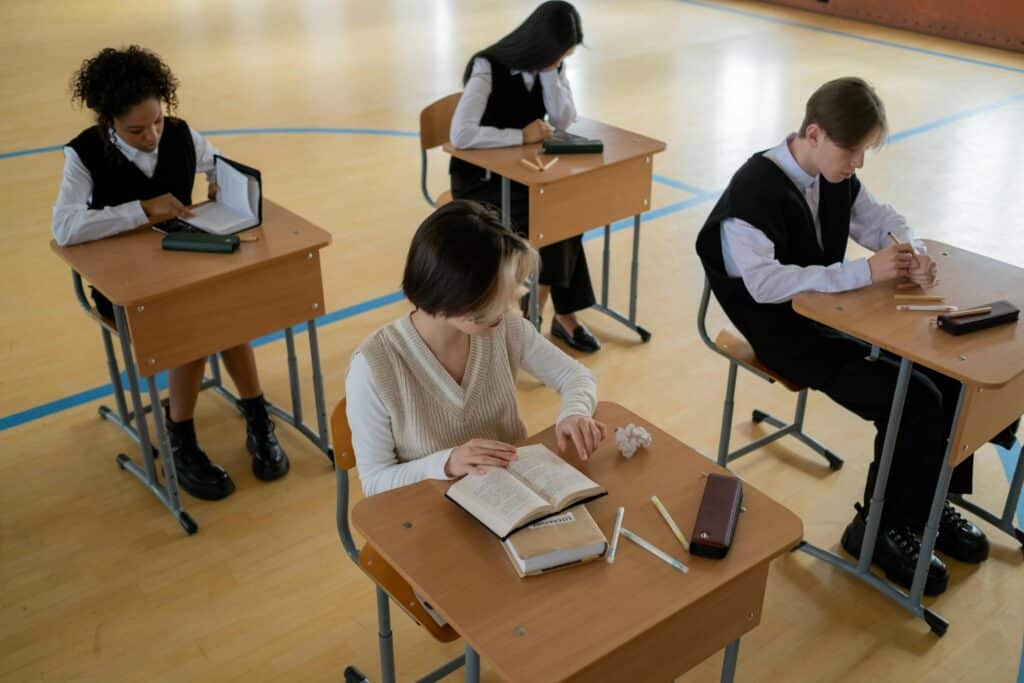
Standardized tests are another major issue. While they provide a measurement of certain knowledge, they often overlook creativity, collaboration, and emotional intelligence. According to the OECD, less than 40% of students feel engaged in classrooms heavily focused on testing (OECD, 2022).
To improve testing and assessment:
- Use alternative assessments: Portfolios, group projects, and presentations can show student growth better than multiple-choice exams.
- Include self-assessment and reflection: Encourage students to evaluate their learning progress and set goals.
- Incorporate real-world problem-solving: Assess how students apply knowledge, not just memorize facts.
Supporting Mental Health

Stress and anxiety are common among students. The American Psychological Association reports that 30% of high school students experience significant stress related to schoolwork (APA, 2023). Stress can hurt focus, memory, and overall academic performance.
Ways to support mental health include:
- Mental health education: Teach students about stress, anxiety, and coping strategies.
- Counseling services: Provide easy access to school counselors or online support.
- Flexible learning options: Allow students to pace themselves, work on assignments online, or participate in hands-on projects.
Leveraging Technology

Digital tools can improve learning and engagement, but many schools haven’t fully embraced them. EdTech Research found that 70% of schools rely mainly on lectures and readings (EdTech Research, 2023), leaving many students disengaged.
To use technology effectively:
- Interactive learning platforms: Tools like educational apps and online simulations help students explore concepts actively.
- Gamified learning: Game-based challenges increase engagement and motivation.
- Personalized learning software: Platforms can adapt to a student’s pace and style.
| Technology Challenge | Current Approach | Suggested Fix |
|---|---|---|
| Limited engagement | Traditional lectures, textbooks | Gamified learning, interactive platforms |
| One-size-fits-all | Same pace for all students | Adaptive software personalized to student progress |
| Minimal feedback | Grades only at the end of term | Real-time feedback from apps and online tools |
Encouraging Student Agency

Students often feel powerless in their education. Giving them choice and control over what and how they learn can boost motivation.
- Student-led projects: Let students select topics they are passionate about.
- Choice in assignments: Offer multiple ways to demonstrate learning (e.g., video, essay, or presentation).
- Peer teaching: Encourage students to teach each other concepts, strengthening understanding.
Case Study: Schools That Made It Work
Some schools have successfully reimagined learning:
- High Tech High, California: Uses project-based learning and real-world applications. Students design their projects and collaborate with peers and community members.
- Finnish Education System: Prioritizes individualized learning, less standardized testing, and a strong focus on student well-being. Students have fewer hours but higher engagement and achievement.
Summary of Solutions
| Problem | Solution | Example/Benefit |
|---|---|---|
| Outdated curriculum | Project-based learning | Real-world problem solving |
| Overemphasis on tests | Alternative assessments | Shows skills, creativity, and collaboration |
| Student stress | Mental health support | Better focus, reduced anxiety |
| Disengagement | Technology integration | Personalized, interactive learning |
| Lack of choice | Student agency programs | Increases motivation and ownership of learning |
By implementing these strategies, the school system can become more inclusive, engaging, and effective. Students can develop critical thinking, creativity, and emotional resilience—skills they will need for life beyond the classroom. ScholarlySphere helps students navigate these changes by providing accessible, insightful blogs and articles tailored to today’s learners.
Moving Forward – A New Vision for Students

The school system as it exists today has many challenges, but it also has great potential. Students often feel unprepared, stressed, or disconnected, yet small, thoughtful changes can make a huge difference. By rethinking curriculum, reducing the emphasis on standardized tests, supporting mental health, leveraging technology, and encouraging student choice, learning can become engaging, practical, and enjoyable.
One of the most important lessons is that education is not just about memorizing facts—it’s about understanding, thinking critically, and applying knowledge. When students are given opportunities to explore, create, and collaborate, they become active participants in their learning rather than passive recipients. ScholarlySphere provides resources to help students navigate this evolving system, offering articles and blogs that give practical tips for learning better and smarter.
Another key insight is the importance of emotional well-being. A student who is stressed or anxious cannot fully engage in learning. Schools that address mental health, offer flexible learning options, and create supportive environments see higher engagement and better academic outcomes. According to the American Psychological Association, 30% of students report significant stress related to schoolwork, highlighting the need for schools to take emotional support seriously (APA, 2023).
Technology also plays a crucial role in shaping modern education. By using interactive learning tools, gamified platforms, and personalized software, students can learn at their own pace and in ways that suit them best. This not only improves comprehension but also makes learning more enjoyable. The use of technology can help bridge gaps that traditional teaching methods often leave behind.
Finally, giving students a voice in their education fosters motivation and ownership. When students can choose projects, select how to demonstrate learning, and even teach their peers, they develop confidence, responsibility, and critical thinking skills. Real-world examples like High Tech High in California show that when students are empowered, engagement and success rise significantly.
Key Points:
- Education should focus on critical thinking, creativity, and real-world skills, not just memorization.
- Emotional well-being is essential for effective learning; stress and anxiety must be addressed.
- Technology can personalize learning and make it interactive and engaging.
- Student choice and agency increase motivation and ownership of learning.
- Schools that implement these strategies see higher engagement and better academic outcomes.
The path to fixing the school system may seem complex, but it begins with understanding the problems and taking actionable steps toward solutions. By combining innovative teaching methods, emotional support, technology, and student agency, education can become a tool for real growth, not just a set of exams and grades. Education is evolving, and students are at the center of this change. Are you ready to take control of your learning and make the most of what the modern school system can offer?
Works Cited
American Psychological Association. Stress in High School Students. https://www.apa.org/news/press/releases/stress/2023/high-school-stress
National Center for Education Statistics. Students’ Readiness for Life After High School. https://nces.ed.gov
OECD. Engagement in Learning Survey 2022. https://www.oecd.org/education/
Brookings Institution. Standardized Testing and Student Outcomes 2022. https://www.brookings.edu/research/standardized-testing-and-student-outcomes/
EdTech Research. Classroom Technology Usage 2023. https://www.edtechresearch.com/