4 Tips on How to Neatly Organize a School Binder
Sarah clutched her overflowing backpack as worksheets scattered across the hallway floor. Sound familiar?
For middle school, high school, and college students struggling with disorganized papers and lost assignments, a well-structured binder system can transform your academic life.
A messy binder creates stress, wastes time, and leadsHomework to missed homework. The right organization system keeps everything accessible when you need it most.
This guide covers practical strategies to help you:
• Choose the Right Binder for Maximum Efficiency
• Set Up Your Binder Sections for Easy Navigation
• Organize Each Class Section for Quick Reference
• Maintain Your Binder Organization Throughout the Year
Why Binder Organization Matters
Students lose up to 40 minutes per week searching for misplaced papers and materials. An organized binder eliminates that frustration completely.
You’ll spend less time hunting for assignments and more time actually learning. Plus, teachers notice students who come prepared with organized materials.
Choose the Right Binder for Maximum Efficiency
Select a binder with minimal friction for easy opening and closing

When learning how to neatly organize a school binder, choosing rings with smooth operation is essential. Teachers recommend avoiding traditional rings that “fly open each time the binder gets picked up.” Look for binders with solid one-touch closing mechanisms that won’t nip fingers and close securely. D-rings hold more paper than traditional circular rings, making them superior for organization. Test the rings before purchasing to ensure they operate smoothly without jamming or unexpected opening during transport.
• Choose D-rings over traditional rings – They hold more papers and provide better organization
• Test closing mechanisms – Ensure one-touch operation without finger pinching
• Verify secure closure – Rings should stay closed when binder is moved around
Pick the smallest size that fits all your materials without jamming
Selecting the right size prevents overstuffing while maintaining portability. A 1.5-inch binder works perfectly for elementary students, while 2-inch binders accommodate middle and high school materials effectively. How to neatly organize a school binder starts with proper sizing – avoid going too large as it encourages disorganization. Consider your course load when sizing; high school students often prefer separate smaller binders per subject rather than one oversized binder for everything.
• Match size to grade level – 1.5″ for elementary, 2″ for middle/high school
• Consider multiple smaller binders – Often more organized than one large binder
• Avoid oversizing – Larger binders encourage poor organization habits
Set Up Your Binder Sections for Easy Navigation
Create separate sections for each class using tabbed dividers
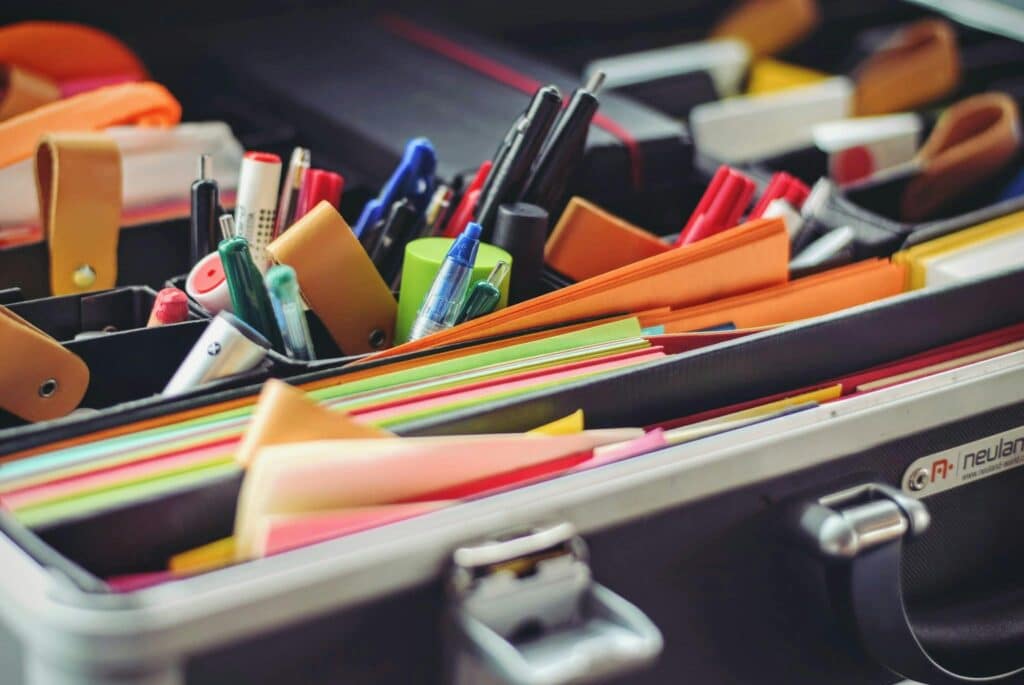
Now that we’ve covered choosing the right binder, establishing clear sections becomes crucial. How to neatly organize a school binder starts with creating distinct compartments for each subject using quality tabbed dividers.
Select insertable dividers that allow you to customize labels for each class. Avery Insertable Dividers offer multicolor tabs that help visually distinguish between subjects. These buff paper dividers with colorful tabs make navigation effortless when you’re rushing between classes.
Key Benefits of Tabbed Dividers:
• Visual separation between subjects prevents mixing up assignments
• Quick identification saves valuable time during busy school days
• Customizable labels adapt to changing class schedules
Position dividers strategically within your binder. Place core subjects like Math, English, Science, and History in the first sections for easy access. Secondary subjects can follow behind these primary divisions.
Consider using plastic dividers for durability throughout the school year. Five Star plastic dividers withstand daily handling better than paper alternatives. Their reinforced edges prevent tearing when students frequently flip through sections.
**Mastering how to neatly organize a school binder requires consistent labeling. Write subject names clearly on each tab using permanent markers or printed labels. Include class periods or teacher names for additional identification when managing multiple sections of the same subject.
Store your class schedule in a sheet protector at the front
Previously, I’ve emphasized the importance of sectioning, but quick reference materials deserve prime positioning. Place your class schedule in a clear sheet protector at the very front of your binder for instant access.
A sheet protector shields your schedule from wear and tear while keeping it visible. This positioning allows immediate reference without disrupting your organized sections. You’ll avoid the frustration of searching through papers when you need to check room numbers or class times.
Essential Schedule Information to Include:
• Class names with room numbers and teacher names
• Daily time blocks and any rotating schedule patterns
How to neatly organize a school binder extends beyond just sections – accessibility matters equally. Position the schedule where it won’t interfere with your divider system but remains immediately visible when opening the binder.
Consider printing backup schedules to store in multiple locations. Keep one copy in your locker and another at home. This redundancy prevents schedule-related confusion when your main binder isn’t available.
Update your protected schedule whenever changes occur. Administrative schedule adjustments happen frequently during the first weeks of school, so maintaining current information prevents missed classes or confusion about room assignments.
Organize Each Class Section for Quick Reference
A. Place frequently used reference materials at the front of each section

Now that we have covered the foundation setup, positioning your most essential materials first makes accessing information seamless. How to neatly organize a school binder starts with strategic placement of syllabi, assignment sheets, and reference guides at each section’s beginning.
• Place original syllabi in sheet protectors as the first page
• Store assignment spreadsheets and class schedules upfront
• Keep reference materials newest on top for easy access
B. Include loose-leaf paper or 3-hole punched notebooks for note-taking
Previously, I’ve emphasized consistent formatting across sections. Adding dedicated note-taking space ensures you’re always prepared for lectures and assignments. How to neatly organize a school binder requires sufficient paper supplies within each class section.
Position blank notebook paper or pre-punched notebooks toward the middle of each section. This placement keeps writing materials accessible while maintaining separation from handouts and completed assignments.
• Store 10-15 sheets of loose-leaf paper per section
• Use 3-hole punched notebooks for extended note-taking
• Replace paper supplies weekly to maintain adequate stock
C. Store class-specific folders at the back of each section
With this in mind, next we’ll see how back-section storage maximizes organization efficiency. How to neatly organize a school binder involves creating designated spaces for completed work and graded materials at each section’s end.
Class-specific folders should contain graded assignments with newest materials on top. This system keeps completed work separate from active materials while maintaining chronological order for easy reference during study sessions.
• Use pocket folders for loose graded assignments
• File completed tests and papers chronologically
• Label folders clearly with class name and semester
Maintain Your Binder Organization Throughout the Year
Weekly and Monthly Cleanouts for Fresh Organization
Now that you’ve set up your binder sections, maintaining your system requires regular cleanouts to remove outdated papers and assignments. How to neatly organize a school binder becomes sustainable when you conduct weekly reviews of each section. Remove completed assignments, old handouts, and expired materials to prevent overcrowding.
Key maintenance benefits:
• Prevents paper buildup and clutter
• Maintains easy access to current materials
• Reduces weight of your binder
Strategic Color-Coding Implementation
Previously, setting up sections was the foundation, but color-coding systems take organization to the next level. How to neatly organize a school binder effectively means matching colored folders with corresponding divider tabs for each subject. This visual system allows instant recognition and faster navigation.
With this in mind, creating designated front pockets for homework ensures easy submission and prevents lost assignments. Store completed work in clear, accessible pockets that how to neatly organize a school binder systems recommend for maximum efficiency.
Designated Homework Storage Solutions

Homework organization essentials:
• Use front pockets for immediate access
• Separate completed from pending assignments
Summary
| Component | Key Strategy |
|---|---|
| Binder Selection | Choose 3-ring binders with solid covers and minimal friction (avoid zippers) |
| Section Setup | Use tabbed dividers to separate classes, keep frequently used items at front |
| Class Organization | Include reference materials, syllabus, paper, and folders for each subject |
| Maintenance | Conduct weekly/monthly reviews to remove outdated papers and reorganize |
Key Takeaways
• Size matters: Select the smallest binder that fits all subjects without jamming papers on rings
• Front section essentials: Keep pencil pouch, hole punch, and class schedule easily accessible
• Color coding: Match folder colors to tab dividers for each class to reduce confusion
• Regular maintenance: Schedule weekly cleanouts to prevent paper buildup and maintain organization
• ADHD considerations: Use velcro closures, wide-ruled paper, and dedicated homework sections for better success
• Strategic placement: Store reference materials in sheet protectors at the beginning of each class section
A well-organized binder transforms from a chaotic paper pile into a powerful academic tool that saves time and reduces stress throughout the school year. The investment you make in setting up these systems properly will pay dividends when you can quickly locate assignments, reference materials, and notes during crucial study sessions.
Ready to revolutionize your academic organization? What’s the first step you’ll take to transform your current binder setup into an efficiency powerhouse?
References
Gambill, Jill M., Lauralee A. Moss, and Christie D. Vescogni. “The Impact of Study Skills and Organizational Methods on Student Achievement.” 2008, ERIC, https://files.eric.ed.gov/fulltext/ED501312.pdf
Heyck-Merlin, Maia. “Backpacks, Planners, and Binders, Oh MY!” Edutopia, George Lucas Educational Foundation, 6 Oct. 2014, https://www.edutopia.org/blog/backpacks-planners-binders-oh-my-maia-heyck-merlin
Sevilla, Gloria. “Using Graphic Organizers in Elementary Math.” Edutopia, 17 Mar. 2025, https://www.edutopia.org/article/using-graphic-organizers-math-elementary-school/
Cole, Alissa M., et al. “The Role of Working Memory and Organizational Skills in Academic Functioning for Children with Attention-Deficit/Hyperactivity Disorder.” Neuropsychology, vol. 38, no. 6, Sept. 2024, pp. 487–500, https://pmc.ncbi.nlm.nih.gov/articles/PMC11469574/
Langberg, Joshua M., et al. “Refinement of an Organizational Skills Intervention for Adolescents with ADHD for Implementation by School Mental Health Providers.” School Mental Health, vol. 3, no. 3, 2011, pp. 143–155, https://pmc.ncbi.nlm.nih.gov/articles/PMC3627380/
Children’s Hospital of Philadelphia, PolicyLab. “Evaluating the Effectiveness of an Organizational Skills Training Intervention for Children with Executive Function Difficulties.” PolicyLab, Nov. 2024, https://policylab.chop.edu/project/evaluating-effectiveness-organizational-skills-training-intervention-children-executive
Molenhouse, C. “Lack of Organizational Skills Interfere with Academic Success.” ERIC, 2000, https://eric.ed.gov/?id=ED445780
BindersInc. “3 Ring Binders: Ring Size and Sheet Capacity.” BindersInc, https://www.bindersinc.com/resources/3-ring-binders
RingBinderDepot. “A Closer Look at D-Ring vs. Round Ring Binders.” RingBinderDepot, 10 Oct. 2023, https://ringbinderdepot.com/blogs/articles/a-closer-look-at-d-ring-vs-round-ring-binders