AI in Education in K-12: Benefits, Best Practices, and Key Ethics

Imagine this: you’re a teacher, you have 8 years of experience, and have to manage grades, make lesson plans, and be there for every student. It sounds exhausting, right?
But you discover AI, and now you have a smart assistant that makes the base for your lesson plans, grades your students’ assignments in seconds, and even personalizes itself for each student.
AI systems can personalize learning for each student and act as an assistant to make running your classroom easier.
This article will discuss:
- How AI personalizes learning and saves teachers’ time
- Ways to address fairness, privacy, and access issues
- Ethical guidelines for using AI in schools
Foundations of AI in K-12 Education
AI in education isn’t about robots or machines roaming around the classroom. It’s about systems of automation that help classroom learning become more efficient and effective.
May it be AI tutoring systems that improve personalized learning, chatbots that can help answer student questions, or tools that save teachers hours in grading and planning.
To be able to use these technologies to their potential, you’ll have to learn and understand when to use or not use these advances in technology.
Defining Artificial Intelligence in Education
When AI gets talked about, we usually imagine robots and machines. However, this AI is different — we are referring to systems that help improve the way we learn and the way learning is done.
If you use AI in K-12 education, you’re using AI that learns from data that it gets, so that it can be personalized.
AIED systems analyze how students learn. They look at your students’ answers, how long they spend on problems, and common mistakes.
The system uses that data to decide what content to show next or which students need extra help. Don’t trust these tools like a person, though — they use complex patterns and algorithms to analyze deeply.
Key Types of AI Technologies in Classrooms
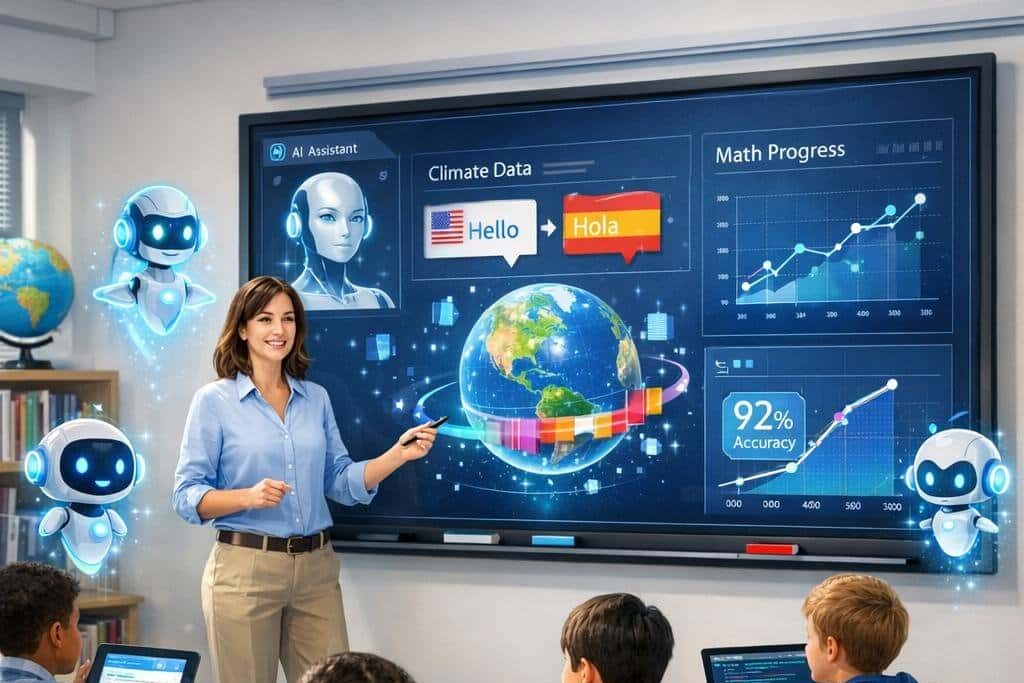
You’ll come across a few main types of AI tools in schools:
Intelligent Tutoring Systems: These help students by adapting to their performance and learning patterns. For example, Carnegie Learning adjusts its math problems according to how well each student is doing.
Automated Grading Tools: These assist with scoring essays and assignments. These systems also check for writing quality, grammar, and whether the question is answered. Gradescope is one prominent example, used primarily for paper-based assignments.
Chatbots and Virtual Assistants: These are available to answer questions a student may have, which gives you more time to focus on bigger tasks. One example is BigBlueButton, which is an open-source virtual classroom designed for teachers that helps with tools like shared notes and polling.
Predictive Analytics Systems: These help identify students who are at risk of falling behind due to poor attendance or grades. One example is PowerSchool Analytics and Insights, which tracks student needs and helps with interventions.
Content Recommendation Engines: These suggest platforms and learning resources based on a student’s interests and performance. An example includes MagicSchool AI, which provides tools for generating lesson plans and suits various grade levels.
Understanding what these tools are — and what they aren’t — is the first step to using them confidently.
Major Benefits of AI for K-12 Students and Educators
AI technology offers teachers and students many advantages when it comes to improving their roles. These tools can create personalized experiences for students and improve work time productivity for teachers.
Let’s look at some further benefits of AI in education.
Personalized and Adaptive Learning
Personalized learning adjusts to one’s individual needs and pace. A key way to implement this is through intelligent tutoring systems, which look at how easily a question is answered and adjust accordingly to difficulty.
Adaptive learning platforms track what’s mastered and what needs work. For example, if a student is stuck on a math problem, the system gives them similar problems until they solve it consistently. Khan Academy usage showed students who used the platform for just 30 minutes a week experienced 20–30% higher-than-expected learning gains on nationally normed assessments like the MAP Growth test.
If a student finds the content too easy, the platform bumps up the difficulty automatically. You’ll also get:
- Real-time data on what each student understands
- Customized lesson paths based on individual progress
- Pacing that adjusts to each student’s readiness automatically
These tools also advise teachers about learning patterns and styles, so if they need to take action, they know when and how. Teachers get clear reports, making one-on-one support far more targeted.
Enhanced Teaching Support and Efficiency

AI handles the unnecessary and repetitive teacher work — grading tests, tracking attendance, and managing student data effectively.
Teachers have more time to plan lessons and actually teach deeply. A Jisc TeacherMatic pilot reported that 51% of participants felt the AI tool saved time creating teaching resources, with an average saving of 2 hours per week, and 69% said it improved learning experiences through feedback, assessments, and mentoring tools.
Here are some admin tasks AI now automates:
- Scoring quizzes and giving instant results
- Creating assignments for different skill levels
- Generating progress reports for parents and admins
- Scheduling and organizing classroom resources
AI also helps teachers find new material. It can suggest videos, articles, and activities that fit your class’s topics and goals.
This allows teachers to skip searching for material and wasting valuable time, so they can focus on making learning involve real-world skills.
Inclusive and Accessible Learning Environments
AI also allows learning to be equal among all. Text-to-speech features can help those with reading difficulties.

Speech-to-text tools let students who find writing tough express their ideas more easily. Translation features mean students who speak different languages can access the same content as everyone else.
The technology can convert written materials into your preferred language right away. Here are some accessibility features powered by AI:
| Feature | Benefit |
|---|---|
| Text-to-speech | Supports students with dyslexia or visual impairments |
| Speech recognition | Helps students with motor skill challenges complete written work |
| Real-time captioning | Assists deaf and hard-of-hearing students during lectures |
| Language translation | Enables non-native speakers to understand course content |
AI shows many possible benefits and possibilities that are not achievable through traditional teaching alone — so consider it.
AI Tools and Applications in K-12 Classrooms
Many different types of AI tools and applications can help perform tasks where energy is wasted, whether it may be teachers looking for help with grading or students looking for helpful tutoring.
Intelligent Tutoring Systems and Automated Grading
Intelligent tutoring systems give your students personalized instruction that goes at their own pace. These systems analyze student answers in real time and adjust accordingly. Teachers who use AI weekly save an average of 5.9 hours.
They spot knowledge gaps and provide practice to help students nail down concepts. Automated grading tools, meanwhile, save teacher time while simultaneously grading homework and tests.
These tools work great for multiple-choice tests, math problems, and even short essays. You can also use them to give feedback according to the grade the student received. Studies show 33% better math outcomes with AI tools, with up to 10x engagement rates compared to traditional methods.
Try this: Start by using an automated grading tool — Gradescope works well for paper-based work. Review the feedback reports after two weeks and look for common patterns: which question did most students miss? That becomes your next mini-lesson.
Some AI-driven adaptive learning systems even provide detailed analytics on general class performance. For example, if you’re teaching a history class, you’ll be able to see which time periods were harder or easier for your students.
Adaptive Learning Platforms

These platforms track how students score on different topics, changing complexity based on how hard or easy it is for them. Students who find it easier move on, while students who are struggling get extra attention, without you having to step in.
Most platforms offer dashboards showing each student’s progress and where they need help. This way, teachers are able to keep up with their students, making learning more personalized. Adaptive learning has demonstrated higher pass rates, with studies showing an increase from 67% in 2016 to 82%.
Try this: Get an adaptive learning platform and in two weeks pull up the dashboard and identify the bottom 20% of students by progress score. Use 10 minutes on Friday to check in with those students personally. The platform flags who needs help, your job is only to make the human connection that can’t be provided by AI alone.
These systems perform well in almost any kind of subject or field, presenting information through videos, interactive exercises, games, and classic practice problems — making class engaging for all.
Generative AI for Content and Lesson Creation
Generative AI tools like ChatGPT help recommend material. They can create quiz questions, prompts, discussion topics, or project ideas.
These tools can also assist with making rubrics, lesson plan outlines, and activity instructions. They can also personalize their outputs according to the information they know about you.
Always double-check, because these tools can produce inaccurate material that doesn’t correspond with your curriculum.
Try this: Use ChatGPT or MagicSchool AI to generate three versions of the same discussion question, one according to low, medium, and high performing students. The optimize according to your curriculum and manually edit, see how it’ll change how your students learn!
Ethical and Social Considerations of AI in Education
The use of AI technology helps with educational outcomes, while raising big questions about privacy and fairness regarding the information it collects and provides.
Data Privacy and Student Safety
These AI systems often gather students’ learning patterns and areas where they excel or struggle. Many of these platforms share data externally, which can put your information in the hands of others.
Educational technology platforms raise privacy concerns because students can’t always understand or agree to how their information is used.
To address this, schools need clear policies about what data they collect and who can see it. As an educator, you should push your administration to share clear documentation on data and third-party access for any AI tool used in the school.
Risks include unauthorized access, data breaches, and companies using student information for commercial gain. Federal laws like FERPA help, but don’t cover all AI activity.
Algorithmic Bias and Fairness
AI systems can also lead to problematic outcomes. Algorithmic bias in education happens when AI makes decisions that disadvantage certain groups.
Common examples of bias in educational AI:
- Automated grading systems favor certain writing styles
- College admissions algorithms that hurt applicants from specific backgrounds
- Personalized learning platforms making wrong assumptions about student abilities
Ethical AI in education demands regular bias checks and transparency about decisions. Schools need diverse teams reviewing AI tools before use. Students and families also need to know when AI influences decisions about personal issues.
Final Thoughts
AI technology keeps reshaping how learning and teaching are done. Traditional methods are evolving, and now personalized teaching assistants and automated tools are taking their place.
AI learning priorities for all K-12 students should always include discussions about responsible use and possible downsides.
AI isn’t coming to replace you, it’s here to give you time back. Time to plan the lesson you’ve been putting off. Time to have the conversation with the student who’s behind. Time to actually enjoy teaching again.
Which tool are you trying first?
Works Cited
Adams, Catherine, et al. “Ethical Principles for Artificial Intelligence in K-12 Education.” Computers and Education: Artificial Intelligence, vol. 4, 2023, article 100131. https://www.sciencedirect.com/science/article/pii/S2666920X23000103
Akgun, Selin, and Christine Greenhow. “Artificial Intelligence in Education: Addressing Ethical Challenges in K-12 Settings.” AI and Ethics, vol. 2, 2022, pp. 431–440. https://link.springer.com/article/10.1007/s43681-021-00096-7
Egwim, Onyinyechi. “AI in Education: Risks and Opportunities for Inclusive K-12 Classrooms.” ResearchGate, 2025. https://www.researchgate.net/profile/Onyinyechi-Egwim-2/publication/396084875_AI_in_Education_-Risks_and_opportunities_for_inclusive_K-12_classrooms
Gökçe, Asiye Toker. “Revolutionizing Education with AI: Ethical Considerations in K-12 Settings.” IntechOpen, 1 Sept. 2025. https://www.intechopen.com/online-first/1230172
Gouseti, Anastasia, et al. “The Ethics of Using AI in K-12 Education: A Systematic Literature Review.” Technology, Pedagogy and Education, vol. 34, no. 2, 2025, pp. 161–182. https://www.tandfonline.com/doi/full/10.1080/1475939X.2024.2428601
Jisc. “TeacherMatic Generative AI Pilot: Findings and Outcomes.” Jisc, 2024. https://www.jisc.ac.uk/reports/teachermatic-generative-ai-pilot
Khan Academy. “MAP Growth Research Report: Khan Academy Efficacy Study.” Khan Academy Research, 2024. https://www.khanacademy.org/research/reports/map-growth
OECD. “Artificial Intelligence and Education and Skills.” OECD, 2026. https://www.oecd.org/en/topics/artificial-intelligence-and-education-and-skills.html
OECD. “What Should Teachers Teach and Students Learn in a Future of Powerful AI?” OECD Education Spotlights, no. 20, 23 May 2025. https://www.oecd.org/en/publications/what-should-teachers-teach-and-students-learn-in-a-future-of-powerful-ai_ca56c7d6-en.html
Reich, Justin, and José A. Ruipérez-Valiente. “The MOOC Pivot.” Science, vol. 363, no. 6423, 2019, pp. 130–131. https://www.science.org/doi/10.1126/science.aav7958
Twarek, Bryan, et al. “AI Learning Priorities for All K-12 Students.” Computer Science Teachers Association, 2 May 2025. https://par.nsf.gov/biblio/10673278-ai-learning-priorities-all-students
UNESCO. “Artificial Intelligence in Education.” UNESCO, 2025. https://www.unesco.org/en/digital-education/artificial-intelligence
U.S. Department of Education. “Artificial Intelligence (AI) Guidance.” U.S. Department of Education, 2025. https://www.ed.gov/about/ed-overview/artificial-intelligence-ai-guidance
Zawacki-Richter, Olaf, et al. “Systematic Review of Research on Artificial Intelligence Applications in Higher Education.” International Journal of Educational Technology in Higher Education, vol. 16, no. 39, 2019. https://educationaltechnologyjournal.springeropen.com/articles/10.1186/s41239-019-0171-0