How to Build a Strong Resume: Essential Tips for Students and Graduates

I once remember staring at a blank document, feeling confused and worried, wondering, “What do I even put on here?”
Maybe you’ve felt that same panic. You put down random different experiences from your academics and maybe clubs or extracurriculars, and then wonder, “Is this enough?”
But here’s the thing: Building a strong resume isn’t about having tons of experience on the document. It’s about showing what you’ve learned in the past, what you can do in the future, and how you stand out in the present.
In this article, you’ll learn:
- How to organize your resume so it’s easy to read
- What sections matter most for students and grads
- Simple ways to highlight your skills and projects
- Common mistakes to dodge when it comes to building a strong resume
Understanding the Basics of a Strong Resume
Building a strong resume starts with a clear, simple, and easily understandable formula. Use simple fonts, keep your sections organized, and highlight what matters most.
What Makes a Resume Effective
The most important part of the resume is the part they see first, so make it effective. You can do this by putting your contact info at the top, then introducing yourself with a quick, powerful summary.
In your summary, mention your field of study, top skills, and how you could be of service to them. Don’t overthink it; a short, direct sentence is better than just pure fluff.
Key elements of an effective resume include:
- Section headings that stand out
- Action verbs at the start of each bullet
- Real examples, not just fluffy words
- Enough white space so nothing feels crammed
Keep it to one page, especially if this is your first interview. Also, focus on your results; for example, “boosted Instagram engagement by 45%,” not just “managed social media.”
Resume vs CV: Key Differences
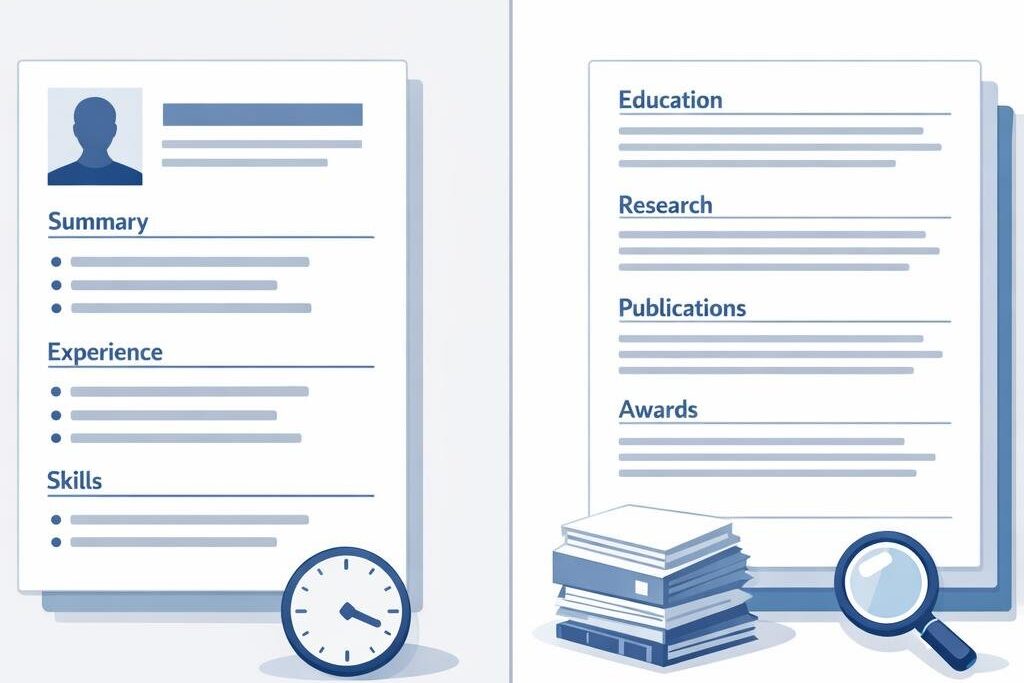
You might ask yourself, “I heard of CVs; why don’t I make one of those?” Resumes and CVs aren’t the same, but they are similar. A resume sums up your experiences and skills in one or two pages and is used just for standard jobs.
CVs go deeper, listing every bit of your academic and professional history. You’ll usually need a CV for academic jobs or fields in medicine.
Main differences:
| Resume | CV |
|---|---|
| 1-2 pages | 2+ pages |
| Tailored for each job | Comprehensive history |
| Focuses on relevant experience | Lists all publications and research |
| Common in business and industry | Used in academia and research |
For most entry-level jobs and internships, use a resume. Then, for jobs like academic research or faculty positions, use a CV.
Common Resume Mistakes to Avoid
Most people make mistakes, but don’t forget to fix them. Typos, grammar mistakes, or messy formatting can make your resume less effective and less appealing.
Mistakes that hurt your chances:
- Using empty buzzwords like “hard worker.”
- Writing an objective instead of a summary
- Listing duties, not achievements
- Mixing up fonts or formatting
- Adding personal info that’s not relevant
Don’t send the same resume to every job. Each job requires a different emphasis on certain types of skills, so change it according to where you’re applying.
Don’t use common, overused phrases like “results-driven.” Talk about your importance, then let your achievements do the rest of the talking.
Structuring Your Resume for Success
If you want hiring managers to see your best skills fast, then structure your resume well. You want clear sections and a direct, easy-to-read layout.
Essential Resume Sections
Start with a simple header: your name, phone number, and professional email address. Keep it simple; better safe than sorry.
Next, add a quick and effective summary about yourself. Just put a few lines to tell employers who you are and your proposition.
Then, for work experience, list your past jobs from most recent to oldest. After including your past job title, company, and dates (when you were hired and when you left), include a few bullet points for each.
For your education section, put your degree type, school, and graduation date. If you’re still in school, just put your graduation date.
Let your best qualities shine, whether on the technical or social side. If you have awards, certifications, or cool projects, add those too.
Choosing the Right Resume Format

My recommendation for most students is to use a chronological format for almost every section. This way it highlights your education and any achievements, starting from the most recent to the past.
If you have little experience, put your education section further up. That way, employers get to see your most relevant qualifications.
If you’re still having problems building the layout, many resume layouts on the internet are easy to use and fairly effective.
Also, for all intents and purposes, stick to standard fonts and clear headings.
Showcasing Your Education and Coursework
Your education section shows employers the knowledge you have, so don’t forget it. Here, list your degree type, academic achievements, and academic certifications.
Highlighting Academic Achievements
If you’re still in school, say “Expected May 2026” or whatever your graduation date is. If you have a higher GPA, like a 3.5, go ahead and include it.
Do you have a dean’s list or scholarships? You can list those right under your academic credentials. You can introduce these with bullet points.
If you did an independent research study, especially if the topic had to do with your job, put the title and a summary of your study. This way, it shows your interest in the field.
Including Relevant Coursework
Preferably, only list classes not related to your job; if you don’t have any work experience, put classes that are related to your job always, as they act as a way to tell your employer that you already have a base of understanding.

Check the job listing, then choose classes according to how related they are. Be specific; don’t overgeneralize when naming your class.
You can also put your coursework right under your degree type, like this:
Bachelor of Science in Marketing, University of Texas — Expected May 2026
Coursework: Consumer Behavior, Digital Marketing Strategy, Market Research, Data Analytics
Also, if you participated in upper-level classes and big projects, make a quick note about it; this is how you build a strong resume.
Certifications, Honors, and Awards
Certifications make your resume shine. List any from big names like Google or Microsoft, and put them in a “Certifications” section.
- Google Analytics Certified, Google, March 2026
- Project Management Professional (PMP), PMI, January 2026
Academic awards: scholarships, research grants, or competition wins should also be included. Group them under “Honors and Awards” or add them to your education section. Skip generic awards that don’t add much value to your resume.
Demonstrating Experience and Skills
When you’re building a strong resume, you don’t want to include unnecessary details about yourself. Instead, introduce your story with examples related to your job. The employer shouldn’t just know who you are but why they should actually hire you.
Presenting Relevant Experience
Start by selecting information about yourself that connects to the job you want.
Worked in retail? You learned customer service. Tutored classmates? That’s teaching and communication right there.
Make sure your past roles align with the job requirements. Use action verbs to show what you accomplished, not just what you did.
Put “Managed team of 5 volunteers” instead of “Was in charge of volunteers.” Numbers help emphasize your results.
Leveraging Internship Experience
Internships also matter by showing you’ve worked in a professional setting before.

Describe firstly your given responsibilities and then the projects you completed. If you used Google Analytics, mention what you tracked and how your analysis helped.
Even if the tasks were basic, you still showed skills essential for every job. Maybe you just filled out documents? That’s organization. You just took meeting notes? That’s attention to detail.
If you’re stuck, you can ask your supervisor what you contributed to them.
Listing Technical & Soft Skills
Create a skills section that focuses solely on your technical and soft skills. Technical skills are specific skills that are required to do specific tasks.
Technical Skills Examples:
- Microsoft Office Suite (Word, Excel, PowerPoint)
- Adobe Creative Suite (Photoshop, Illustrator)
- Programming languages (Python, Java, HTML/CSS)
- Data analysis tools (Excel, Google Analytics, Tableau)
- Foreign languages (specify proficiency level)
Soft skills are behavioral and social skills that tell how well you can work with others.
Soft Skills Examples:
- Communication
- Problem-solving
- Leadership
- Teamwork
- Time management
When building a strong resume, only include skills you actually have and can defend/demonstrate.
Creating an Impactful Opening Summary
When building an effective resume, your resume intro has to be eye-catching so that your employer finds potential in you; your first impression can make or break your shot at an interview.
If you have any relevant internships, part-time work, or volunteer experience, use a summary. This lets you quickly allow your employer to see your results and skills. A strong summary shows real value.
Craft your summary so that it mentions your strongest qualifications in just a couple of sentences. Mention two or three skills that are related to the job and a specific achievement, as an example. Also, make sure you put numbers so your achievements are quantifiable.
One example: “Business administration graduate with three internships in financial analysis. Proficient in Excel modeling and data visualization. Reduced reporting time by 30% through process improvements during final internship.”
Expert Resume Writing and Design Tips
A strong resume pays attention to detail and uses actionable language. The way you articulate your experiences and present yourself makes a difference.
Using Action Verbs and Quantifiable Achievements
When using bullet points, start with strong action verbs. Words like “developed,” “managed,” “coordinated,” and “analyzed” add extra value to your points.
Numbers are probably even more important; they make your achievements memorable and impressive. Instead of “helped increase sales,” try “increased sales by 23% over six months.”
You can quantify almost anything, using percentages, dollars, time saved, or the number of people you worked with, but primarily rely on results. Highlight your accomplishments over just your job responsibilities.
Formatting, Proofreading, and Review
Keep your formatting consistent throughout your entire resume. Stick to the same font size and type throughout.

Don’t switch it up halfway through. It may sound small, but little details like that make your resume that much more readable.
Writing a resume takes time and requires effective time management. Read your resume out loud, and then fix any awkward sentences that may be in there.
Double-check all your stats and dates. Make sure everything you add to your resume is up-to-date, including your contact information. Don’t let that be the reason why they don’t contact you.
If you want to be more secure, you can give your resume to your friends, family, or colleagues; they can offer advice that may further strengthen your resume.
Finally, save your final resume as a PDF to lock in your formatting. Give the file a clear name, and then submit.
Final Thoughts: The Perfect Student Resume Guide
The importance of building a strong resume is more than people think. A resume can either land you the job of your dreams or get you rejected.
Building a strong resume takes time, but once you apply these strategies, you’ll stand out from other candidates. You can start by improving just one section, then the next. Whether you’re a student or a recent graduate, following these steps can significantly increase your chances of being chosen for the position.
So, which one of these tips will you incorporate into your resume?
References
“Essential Skills to Put on Resume as a Student.” College Ave, 23 Jan. 2025, https://www.collegeave.com/articles/essential-skills-to-put-on-your-resume-for-students/
“Resume Skills for Students and Internships: A Complete Guide.” CV Owl, https://www.cvowl.com/blog/resume-skills-for-students-and-internships
“How To Write an Effective Resume Summary (With Examples).” Indeed, 19 Jan. 2026, https://www.indeed.com/career-advice/resumes-cover-letters/writing-a-resume-summary-with-examples
Pichura, Irina. “How To Build A Strong Resume with Examples, Tips, and Guide.” Resume.org, 25 Sept. 2025, https://www.resume.org/career-center/how-to-build-a-strong-resume-with-examples/
Morgan, Sebastian. “How to Make a Successful Resume in 2026 (8 Easy Steps).” Resume Genius, 5 Jan. 2026, https://resumegenius.com/blog/resume-help/how-to-write-a-resume
“25 Resume Objective Examples: When Objectives Actually Work (And How to Write Them for 2025).” The Interview Guys, https://blog.theinterviewguys.com/25-resume-objective-examples/
Augustine, Amanda. “Ask Amanda: How Are a Resume Objective and a Resume Summary Different?” TopResume, 10 June 2024, https://topresume.com/career-advice/ask-amanda-how-are-a-resume-objective-and-a-resume-summary-different
Chase, Ken. “27 Great Resume Summary Examples to Get Hired.” TopResume, 26 Nov. 2024, https://topresume.com/career-advice/write-the-ultimate-resume-summary