From Wagons to the First School Bus
Imagine this: it’s the year 1905, and you’re a student living in a small rural town. Instead of walking to school along a dusty dirt road, you climb into a long wooden wagon pulled by two horses. The wagon is crowded, bumpy, and noisy. There are no windows to keep out the cold winter wind, and if it rains, everyone gets wet. This was the reality for many kids before the modern school bus existed. These wagons even had a name—kid hacks. They were designed to “hack” or pick up children and bring them to one-room schoolhouses. (Wikipedia)
Kid hacks were an improvement over walking long miles, but they had many problems. They were slow, unsafe, and uncomfortable. Sometimes students had to sit on wooden benches that ran along the sides of the wagon. If the wagon tipped or the horses spooked, kids could fall out. Even though they weren’t perfect, kid hacks were the first step toward the school bus we know today.
By the early 1900s, the world was changing quickly. Automobiles were becoming more common, and inventors began thinking about ways to use trucks for carrying students. Around 1914, a company called Wayne Works in Indiana created one of the first motorized school buses. They built wooden bus bodies and placed them on top of truck frames. These early motor buses looked like wagons but could travel farther and faster than horse-drawn hacks. They became popular in rural areas, where long distances made walking impossible.
In the 1920s and 1930s, companies began experimenting with new materials and safer designs. Steel replaced wood, which made buses sturdier and less likely to break apart in accidents. Windows were added to protect kids from wind and rain. Slowly, the school bus became more than just a ride—it became a symbol of progress in education. (Transfinder)
A major turning point came in 1939. Frank W. Cyr, a professor from Teachers College, Columbia University, believed there needed to be national rules for building school buses. At the time, buses looked different depending on where you lived—some were red, some were green, and others still looked like wagons. Cyr organized a conference with educators, safety experts, and transportation leaders. Together, they created 44 national standards that would shape the modern school bus.
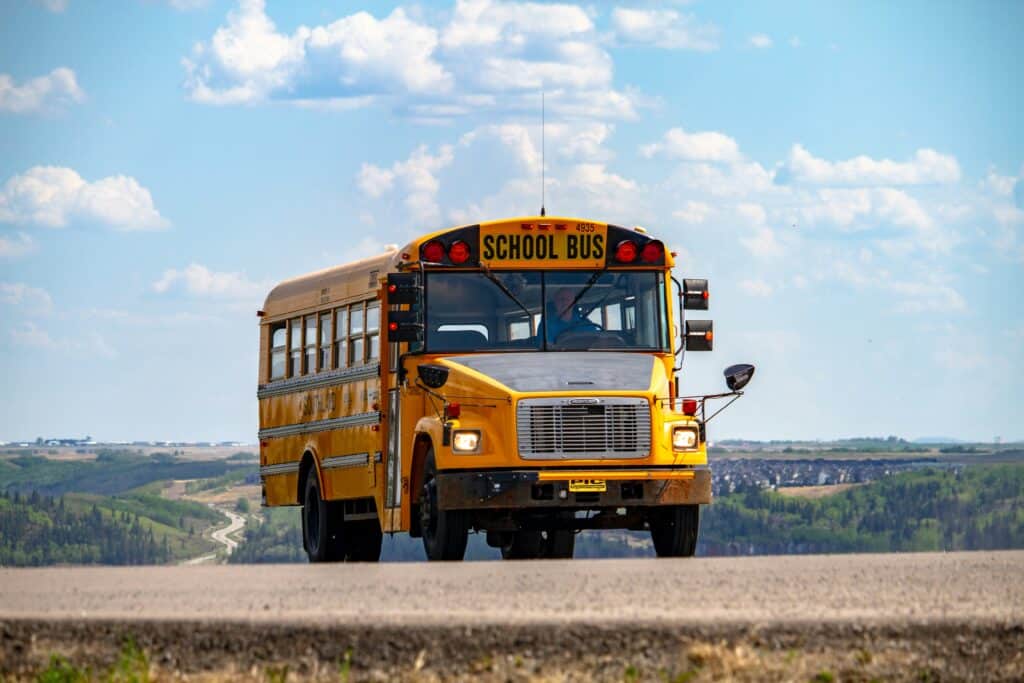
One of the most important decisions from that meeting was the color. The group agreed that every bus should be painted the same bright yellow. This was not chosen at random—scientific research showed that yellow is one of the easiest colors to see, especially in the dim light of morning and evening. Black letters on yellow backgrounds were also easier to read at a distance. That’s why the shade became known as “National School Bus Glossy Yellow.” From then on, yellow became the law for school buses across America. (Wikipedia)
The 1939 conference also decided how buses should be shaped and built. They required stronger roofs, emergency exits, and better seating. These safety standards made the school bus one of the safest forms of transportation in the United States. It was the beginning of a new era where every student, no matter where they lived, could rely on a bus that looked and worked the same way.
Looking back, the journey from kid hacks to bright yellow buses shows how innovation happens step by step. What started as a simple wagon pulled by horses became a carefully designed vehicle that carries millions of children safely every day. The school bus is more than just a vehicle—it’s a moving classroom on wheels, a place where students laugh, share stories, and prepare for the day ahead. And it all began with those humble wooden hacks rattling down country roads over a century ago.
Why School Buses Are Yellow — Safety, Science, and the Numbers
One of the first questions people ask about the school bus is simple: why yellow? The short answer is visibility. In 1939 a group of experts led by Frank W. Cyr set national standards for school buses, and they picked a special yellow because tests showed that black letters stand out best on that color in dim light and drivers spot it easily from a distance. That conference made the color a standard that helped every school bus look the same on the road.
The Science of Yellow
Yellow works for two main vision reasons. First, our eyes notice yellow quickly in low light — like early morning or late afternoon when many kids ride. Second, yellow sits near the edge of what our side vision (peripheral vision) sees best, so drivers can spot a school bus even when they are not looking straight at it. Scientists who study human vision have found that yellow wavelengths are processed by the eye faster than many other colors, which means drivers react quicker. This tiny difference in reaction time can prevent accidents.
Why yellow works so well:
- Our eyes detect yellow faster than most colors.
- Black text on yellow has the highest readability at a distance.
- Yellow is linked with “caution” in road signs and traffic lights.
- Side (peripheral) vision spots yellow more easily than red.
- In dim light, yellow stands out more clearly than blue, green, or white.
Built for Safety
Beyond color, school buses are designed to protect riders. Big yellow buses use a safety idea called compartmentalization: strong, closely spaced seats with energy-absorbing backs that help protect kids if the bus stops suddenly or is hit. Because of designs like these and other rules, riding a school bus is much safer than riding in most cars. Government studies say that the fatality rate for buses is far lower than for passenger cars when compared by miles traveled.
Top safety features of school buses:
- Compartmentalized seating – Padded, closely spaced seats act like protective shells.
- Bright yellow paint and black lettering – Maximizes visibility in all conditions.
- Flashing red and amber lights – Signal when the bus is stopping or loading.
- Stop arms – Swing out to block passing cars.
- Crossing control arms – Extend from the front bumper to guide students safely in front.
- High, reinforced seats – Keep students protected in collisions.
- Strong body frames and stiffened roofs – Prevent collapse in rollovers.
- Emergency exits – Side doors, rear doors, and roof hatches give multiple escape routes.
The Numbers Behind Safety
| Fact | Number | Source |
|---|---|---|
| Yellow school buses in the U.S. | ~480,000 | NYSBCA |
| Students riding daily | ~26 million | NYSBCA |
| Fuel saved yearly | ~2.3 billion gallons | NYSBCA |
| Annual family savings | $7 billion+ | NYSBCA |
| Deaths in bus-related crashes | 100–140 (all people involved) | NHTSA |
| Student deaths on buses per year | About 6 | NSTA White Paper |
What the numbers tell us:
- Most fatalities in school bus crashes involve other vehicles or pedestrians, not bus riders.
- Students are 8–20 times safer on a school bus than in a car.
- The fleet of school buses is the largest public transportation system in the U.S.
- Families save billions each year because buses replace millions of car trips.
Sidebar: What About Seat Belts on School Buses?
One question students often ask is: if cars need seat belts, why don’t all school buses have them? The answer is partly design and partly cost. Large buses are built with compartmentalized seating, which protects children in most crashes by absorbing force across padded seats. Smaller buses, which don’t use the same design, often do have seat belts. Some states — like California, New Jersey, and Texas — require seat belts on all new school buses, while others leave the decision up to local districts. Researchers continue to study whether adding belts on every large bus would add more safety or if the costs and delays make it harder for districts to provide service.
Quick seat belt facts:
- Large buses rely on compartmentalization instead of belts.
- Small buses almost always require belts.
- States like California and Texas mandate belts on new buses.
- The debate continues: belts may help in rollovers but raise cost and space issues.
School Bus Laws on the Road
Yellow buses don’t just rely on their color — they also have special rules. In almost every state, drivers must stop when a school bus has its red lights flashing and stop arm extended. Passing a stopped school bus is against the law and can lead to fines, license suspensions, or even jail time. Sadly, surveys show that thousands of drivers illegally pass buses each day, putting students at risk.
Key laws drivers must follow:
- Stop when the red lights flash and the stop arm is out.
- Remain stopped until the bus moves or the lights turn off.
- Never pass a bus on the right when students are loading or unloading.
- Watch carefully for kids crossing the road — they may be hidden from view.
Going Green: The Future of School Buses
New technology and environmental goals are changing the yellow fleet now. Electric school buses can cut air pollution and reduce health risks for children who are especially sensitive to diesel exhaust. Recent federal and local programs have paid to replace diesel buses with electric models, but the switch is slow and faces problems like cost, charging infrastructure, and supply chain delays. Still, experts say modernizing the school bus fleet could lower pollution and health problems near schools.
Benefits of electric school buses:
- No exhaust fumes – Cleaner air for kids with asthma or allergies.
- Lower fuel costs – Electricity is cheaper than diesel over time.
- Quieter rides – Less noise pollution for students and neighborhoods.
- Climate benefits – Lower greenhouse gas emissions.
- Energy storage – Future buses may return power to the grid during emergencies.
A Global View
Not every country uses yellow.
- Canada – Uses yellow buses almost identical to U.S. models.
- United Kingdom – Students often ride regular public buses, not yellow school buses.
- Japan – Many schools use colorful buses decorated with cartoon characters.
- Other countries – Use a mix of vans, minibuses, or public transportation.
These differences show how the school bus reflects culture — but in the U.S., yellow remains the trusted signal for safety.
Final Thoughts on Yellow
In short, the yellow school bus became standard because science and safety experts wanted one color that drivers would see quickly and clearly. Combined with strong design rules, safety features, and careful driving laws, that color and those standards help protect millions of students every day. But the system still depends on drivers following the rules, good maintenance, and new investments — like electric buses — to make the ride safer and healthier for everyone.
Learning Beyond the Yellow Bus
When we think about the school bus, most of us picture a big yellow vehicle waiting at the corner every morning. But the story of the school bus is more than transportation — it is a lesson in history, safety, science, and even community. By learning how buses were created and why they are designed the way they are, students also learn about teamwork, problem-solving, and the way rules are made to keep people safe.
Stories like this matter because they show that learning doesn’t only happen in classrooms. It happens every time we ask questions: Why is the bus yellow? Who decided the rules? How do buses affect our community? When we explore answers, we begin to connect history, science, and daily life.
How Blogs and Articles Help Students
Today, students have more ways to learn than ever before. Blogs and online articles give quick, easy-to-read lessons about topics that sometimes never get covered in school textbooks. For example, an article about the history of school busesmay explain:
- The 1939 conference that set national standards.
- The science of visibility and why yellow works best.
- The laws that protect students riding to school.
- Modern changes like electric buses and environmental benefits.
Blogs are powerful because they:
- Break big ideas into simple language.
- Use pictures, tables, and bullet points to explain facts.
- Share real-life stories that students can connect with.
- Give free access to information outside of school hours.
By reading posts about school and education, students see how small details — like the color of a school bus — connect to larger themes about safety, learning, and community.
The Role of Scholarly Sphere
Websites like Scholarly Sphere give students a place to explore researched information in a way that feels approachable. When blogs and articles highlight school and learning topics, they help students:
- Practice reading and critical thinking.
- Discover new interests, such as engineering, design, or law.
- Connect history and science to everyday experiences.
Even though not every topic is taught in class, Scholarly Sphere and similar platforms help fill in the gaps. They act as bridges between school learning and independent curiosity.
Why Students Should Care About the School Bus Story
At first, the history of the school bus might seem like just another fact. But when we look closer, we see lessons that affect every student:
- Safety first – Buses show how rules protect kids every day.
- Teamwork matters – Experts came together in 1939 to solve a problem.
- Design shapes behavior – A color choice can change how millions of drivers act.
- Learning is everywhere – Even a bus ride has science and history behind it.
These lessons remind us that curiosity turns ordinary things into opportunities for learning.
Conclusion
The yellow school bus is not just a ride to school; it is a moving classroom that teaches lessons about safety, design, and community. Blogs, articles, and platforms like Scholarly Sphere help us look deeper into these everyday objects, showing students that learning can happen anywhere. The next time you see a school bus on the road, will you think of it as just a ride — or as a story waiting to be explored?
References
National Highway Traffic Safety Administration (NHTSA). School-Transportation-Related Crashes. U.S. Department of Transportation, 2023.
https://crashstats.nhtsa.dot.gov/Api/Public/ViewPublication/812013
National School Transportation Association (NSTA). The Yellow School Bus Industry: Safety, Security, and Environmental Benefits. NSTA, 2022.
https://s3-us-west-2.amazonaws.com/nsta/6571/Yellow-School-Bus-Industry-White-Paper.pdf
New York School Bus Contractors Association (NYSBCA). Fast Facts About School Buses. NYSBCA, 2023.
https://www.nysbca.com/fastfacts
National Highway Traffic Safety Administration (NHTSA). School Bus Safety: Crash Data and Regulations. NHTSA, 2022.
https://www.nhtsa.gov/road-safety/school-bus-safety
National Center for Biotechnology Information (NCBI). Human Peripheral Vision and Color Sensitivity. U.S. National Library of Medicine, 2018.
https://www.ncbi.nlm.nih.gov/pmc/articles/PMC6134457/
National Academies of Sciences. School Bus Occupant Protection: Compartmentalization vs. Seat Belts. Transportation Research Board, 2018.
https://nap.nationalacademies.org/catalog/25000
World Resources Institute (WRI). The Case for Electric School Buses. WRI, 2023.
https://www.wri.org/insights/electric-school-buses
U.S. Environmental Protection Agency (EPA). Clean School Bus Program. EPA, 2023.
https://www.epa.gov/cleanschoolbus