
How to Improve Your Academic Problem-Solving Skills for College: Proven Strategies

Imagine this: it’s late in the night, and you have homework due, and while looking at it, your mind goes blank, and you can’t think straight.
Sometimes you just want to procrastinate your assignments and do something else. But what if there were techniques that could help you not feel confused and even feel prepared.
That’s what Improving Your Problem-Solving Skills for College is about. Here’s what you’ll find in this article:
- Step-by-step habits to tackle tough problems faster
- Ways to boost your thinking and study routines for better academic results.
- How to use tools and support so you don’t get confused.
The Importance of Academic Problem-Solving Skills
College can be very difficult for most people. That’s where improving your problem-solving skills is important. It helps you solve problems faster and feel less confused.
Once you get better problem-solving skills, you’ll be able to solve problems faster and complete assignments with more efficiency. It also helps you pick study techniques that are the best for you.
How Problem-Solving Skills Influence Academic Success
Let’s say you’re stuck in a hard assignment. It’s easier to layout a game plan and examine your reasoning and strategy.
Start by figuring out what the actual question is. Jot down what you know and what’s missing. This will help make your research faster and help keep you from wasting hours without any progress.
Turn your big projects into smaller, more manageable 30–90-minute chunks. Try out one solution at a time, and note what works. This helps you procrastinate less and get your grades up.
Critical Thinking vs. Problem-Solving in College
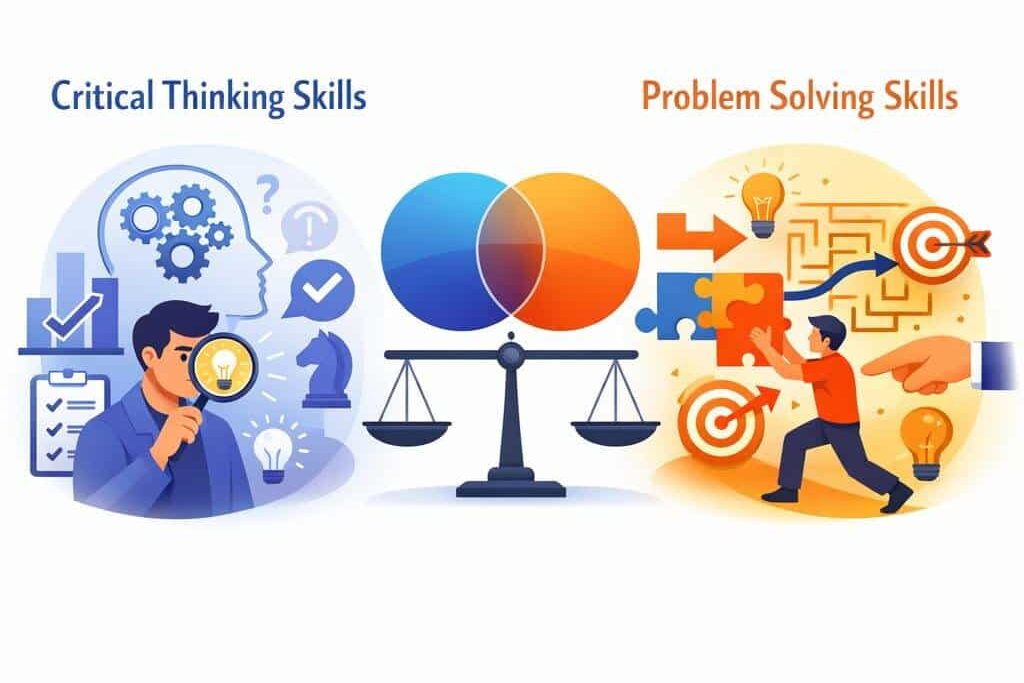
Critical thinking and problem-solving are similar, but they’re not the same. Critical thinking helps you evaluate reasoning and claims and helps your see ideas logically.
Problem-solving adds on to that by emphasizing action. You move from thinking to doing: instead of asking “what,” you go into ask “how.”
For example in lab reports, critical thinking would be used to make logical sense of data, but you’ll need problem-solving to fix an experiment. That’s gone wrong. Both are key, but problem-solving is what gets you from lost to moving.
Core Elements of Academic Problem-Solving
You’ll need a step-by-step plan; you have to identify the problem, than inform yourself with info, then make a decision according to your goals and objectives. Put more attention on techniques that you can do anywhere.
Understanding and Identifying the Problem
You can start by naming the problem in one sentence. Write down what you want to accomplish and what’s holding you back.
This helps you by showing you the problem (like low quiz scores) from root causes (maybe missing some key skills). To find the root cause, ask questions like When did this start? Or “what did I do differently?”
Don’t just assume every bad grade comes from not studying enough.
Strategies for Analyzing Information
Make sure the facts you get information from primary sources. Your notes, assignments, lab results, and feedback. You can also use a chart or table to compare what you first expected and what actually happened.

Check for clarity and bias. Who made this data? When? and don’t use it until your certain it is credible.
You can also try a pros/cons list, cause-and-effect diagrams, or quick number checks. These tools help you test you understanding and thinking. You should use you logic to make action and then be able to explain it with your logic and reasoning skills.
Making Informed Decisions
Connect possible solutions to what you analyzed. For each solution, jot down the benefits, the downsides, and the steps needed to get to them.
Pick the solution that suits the situation best and where the steps are practical. If you are not sure which one to choose, you can run a little test and see which one is the best.
After you try it, check if the results match your goals. If they don’t match your goals, go back and retry with a different approach until your solutions match your goals.
Practical Strategies to Strengthen Problem-Solving Skills
Want help? These techniques we help you be able to develop your problem solving skills and help inform yourself brain so it is more capable, you can do this alone and with others.
Effective Brainstorming and Creative Thinking
To brainstorm effectively, you need to start with an effective question, like, “How can I cut errors in my lab protocol?” Limit brainstorming to under 10 minutes so you can produce ideas efficiently.
You can use a timer to make sure you under 10 minutes and then write down the ideas that come to you.
Then you can work alone a bit, and then, if you’re in a group discussion, you can exchange ideas with others. You can do multiple rounds; in the first round, don’t judge, just listen and think clearly. Then for the next rounds you can actually discuss and judge logically.
You can make mind maps or simple charts: one side for ideas and the other for discussing its limits. This way, you can spot which one would make the most sense.
Evaluation of Solutions and Decision-Making Skills

Set what you want before looking at choosing a solution. Look at its feasibility (can you do it?), its impact (how much does it help?), and its risk (what could go wrong?). You can score each from 1–5.
Here’s a quick decision table:
| Option | Feasibility | Impact | Risk | Total |
|---|---|---|---|---|
| A | 4 | 3 | 2 | 9 |
| B | 2 | 5 | 3 | 10 |
Then test out your best idea and scale it again. For essays, draft a quick outline or a single paragraph. For experiments, try a mini trial. Just make sure you want to continue firmly with your idea.
When you choose firmly, write a short plan with some clear steps and deadlines, and then distribute work if you’re in a group project.
Reflective Thinking and Continuous Improvement
After finishing, take 10–15 minutes to reflect. Ask yourself: What things worked? What failed? How could I have done it better?
You can do this by writing in your journal once a week; some improvements are possible. Possibly like “practice drawing process diagrams” or “use the decision table before the next paper.”
Then implement those tiny changes, and you’ll see a noticeable difference in you problem-solving skills over the long run.
Resources and Support for Academic Problem-Solving
Dont forget, there are many types of academic sources around you that can help you along the process of improving your problems solving skills. Look for ones that have a structured plan, allow feedback, and lets you explain your reasoning.
Leveraging Tutoring and Academic Support Services
To start, you can consider one-on-one or small-group tutoring for classes in which you need help. You can ask them to explain their steps then you can repeat them yourself.
You can also bring them an assignment you may have not done well in. This way they can help you see what areas you have to improve in.
Your school’s academic support center can be a goldmine where you can further better you college problem-solving skills.
If you have access to academic coaching , don’t hesitate to set up a meeting. Coaches can help build a plan on how to better your academics; they can guide you on how to study properly or assignments to put your priority on.
Taking class sessions online is also an option. But it’s important to double-check if they come free with your tuition. Lots of colleges now let you book sessions and upload assignments through their LMS platforms.
By making your tutoring a consistent part of your schedule, you’ll see progress in no time.
Online Courses and Self-Directed Learning

To start you can try short courses that dig into problem-solving frameworks and critical thinking.
Also pick courses that emphasize improving. You need platforms that give you practice and feedback, not just endless videos. This is how you progress.
And when you make mistakes, treat them as the next step to improve in, not just a loss. This is how you create a mindset suited for problem-solving.
Final Thoughts
The importance of improving your problem-solving skills can not be understated. It is the cornerstone of how you’ll become more effective and efficient when it comes to your academics. The more you apply these strategies, the easier it becomes to handle difficult assignments.
Over time, you’ll notice yourself thinking faster, working smarter, and feeling more confident in your ability to solve problems.
Now, the real question is, which of these techniques will you implement today?
References
Academic Success Center.” St. John’s University, https://www.stjohns.edu/academics/centers-institutes/academic-success-center
“Active Learning & Metacognition.” Teaching Support and Innovation, University of Oregon, https://teaching.uoregon.edu/resources/active-learning-metacognition
“Collaborative Learning.” Center for Teaching Innovation, Cornell University, https://teaching.cornell.edu/teaching-resources/active-collaborative-learning/collaborative-learning
“Critical Thinking and other Higher-Order Thinking Skills.” Center for Excellence in Teaching and Learning, University of Connecticut, https://cetl.uconn.edu/resources/design-your-course/teaching-and-learning-techniques/critical-thinking-and-other-higher-order-thinking-skills/
“Designing Reflective Writing for Meaningful Learning.” Center for Teaching Excellence, Texas A&M University, https://cte.tamu.edu/resources/designing-reflective-writing.html
“Improving Critical Thinking Skills in College Students.” Division of Teaching Excellence and Innovation, University of California, Irvine, https://dtei.uci.edu/2020/03/06/improving-critical-thinking-skills-in-college-students/
“Metacognitive Study Strategies.” The Learning Center, University of North Carolina at Chapel Hill, https://learningcenter.unc.edu/tips-and-tools/metacognitive-study-strategies/


Pingback: Engaging Math Games to Boost Student Focus in Class