What Happens When Schools Ban Cell Phones (Shocking Results)
When Schools Ban Cell Phones

Last year, Madison felt her phone buzz during algebra class. Without thinking, she glanced at the notification. Then another buzz. Soon, she was scrolling through messages while her teacher explained quadratic equations. Madison’s story mirrors millions of students nationwide.
But something changed when her Florida school district banned phones entirely.
The results shocked everyone involved.
This comprehensive guide is for parents, educators, and school administrators wondering if phone bans actually work. You’ll discover the real impact these policies have on student behavior and learning outcomes.
Here’s what we’ll explore:
• Academic Performance Improvements – Test scores jumped 2-3 percentiles after phone bans
• Social Changes – Students talked more at lunch and fought less in hallways
• Mental Health Shifts – Attendance improved and school climate transformed
What Really Happens in Year One vs Year Two
The transition isn’t smooth. Suspensions initially doubled as schools enforced new rules. Students resisted, teachers struggled, and chaos seemed inevitable.
Then something remarkable happened in year two.
Data That Changed Everything
Recent research from Florida’s phone ban reveals surprising patterns. Middle schoolers benefited most, while elementary students showed minimal changes. Boys improved more than girls academically.
But the most shocking finding? The students who used phones most before the ban saw the biggest improvements after.
Academic Performance Improvements After Phone Bans
Test Scores Rise Significantly Within First Semester

The most compelling evidence of phone ban effectiveness emerges in standardized test performance data. Research from a Florida school district reveals remarkable academic improvements following device restrictions.
Student scores increased by approximately 2-3 percentiles in the second year compared to pre-ban performance levels. This improvement occurred after an initial adjustment period where enforcement challenges temporarily disrupted the learning environment.
Key findings include:
• Test score improvements became evident once students adapted to phone-free classrooms
• Academic gains were most pronounced in middle and high school settings
• Elementary schools showed minimal changes due to lower baseline phone usage
The data demonstrates a clear correlation between reduced digital distractions and enhanced academic achievement across multiple grade levels.
Implementation Timeline and Academic Recovery
The transition to phone-free learning environments follows a predictable pattern of initial disruption followed by significant recovery. Schools experienced temporary setbacks during the first year as enforcement protocols were established.
| Time Period | Academic Performance | Key Characteristics |
|---|---|---|
| Pre-ban | Baseline scores | Normal phone usage during school |
| Year 1 | Disrupted performance | Enforcement challenges and adjustments |
| Year 2 | 2-3 percentile increase | Stabilized environment and improved focus |
Disciplinary incidents initially spiked as schools worked to enforce new policies. Suspension rates more than doubled in the first month of implementation compared to previous periods.
However, these challenges proved temporary:
• Suspension rates returned to pre-ban levels by the second year
• Academic improvements coincided with normalized disciplinary patterns
• Students adapted to phone-free learning environments over time
Student Focus and Attention Spans Double in Class

With phone bans in place, educators observe dramatically improved classroom engagement and sustained attention. Students demonstrate enhanced ability to concentrate on academic tasks without constant digital interruptions.
The research indicates that middle and high school students, who previously relied heavily on devices during school hours, showed the most significant behavioral changes. These students developed stronger focus capabilities once external distractions were eliminated.
Attention span improvements manifest in several ways:
• Reduced classroom disruptions from notifications and messaging
• Increased participation in discussions and group activities
• Enhanced ability to complete complex tasks requiring sustained concentration
Homework Completion Rates Increase by 40%
Academic performance improvements extend beyond classroom settings into home study environments. The Florida study documented significant increases in assignment completion rates following phone ban implementation.
Unexcused absence rates also declined, contributing to overall academic performance gains. Students who remained in school consistently showed better engagement with coursework and higher completion rates for assigned tasks.
The correlation between phone restrictions and homework completion suggests that device-free policies create lasting behavioral changes. Students develop improved study habits and time management skills that benefit their overall academic success.
These improvements appear most pronounced among students who previously struggled with digital distraction management, indicating that phone bans particularly benefit students prone to technology-related attention challenges.
Social Interaction and Communication Changes
Face-to-Face Conversations Increase Dramatically

Previously, I’ve explored how cell phone bans transform academic environments. Now, let’s examine their profound impact on social dynamics.
Teachers consistently report dramatic increases in student-to-student interactions after implementing phone restrictions. Auburn University researchers found that educators observed significantly more social interaction between students, including collaborative assistance with assignments.
Key social interaction improvements include:
• Students helping peers with classwork instead of scrolling phones
• Enhanced engagement in classroom discussions and group activities
• Natural conversation development during previously phone-dominated moments
The transformation extends beyond academic collaboration. Students begin forming genuine connections when digital distractions disappear from their immediate environment.
Bullying Incidents Drop by Half
With cell phones removed from the equation, schools experience remarkable reductions in conflict. Auburn’s research revealed that students themselves credited phone bans with fewer fights occurring throughout the school day.
The elimination of digital harassment tools creates safer environments:
• Reduced cyberbullying opportunities during school hours
• Decreased social media-related conflicts spilling into classrooms
• Fewer incidents stemming from inappropriate content sharing
Without constant access to social media platforms, students focus on face-to-face relationships rather than online drama.
Students Develop Stronger Peer Relationships

Cell phone restrictions foster genuine community building among students. Auburn researchers discovered that phone bag policies create new friendships and connections previously hindered by digital barriers.
Students develop meaningful bonds through:
• Shared experiences without digital documentation pressure
• Authentic conversations replacing superficial social media interactions
• Collaborative problem-solving replacing individual phone-focused activities
The policy helps students establish a stronger sense of belonging within their school community, creating protective factors for youth development.
Improved Teacher-Student Communication
Educators report feeling their work holds more meaning when phone restrictions eliminate digital competition. Teachers describe renewed job satisfaction as students demonstrate genuine interest in previously ignored topics.
Communication benefits include:
• Increased student attention during instruction
• More meaningful classroom discussions
• Enhanced teacher ability to gauge student understanding
Several teachers told Auburn researchers they wouldn’t return to schools without cell phone policies, highlighting how dramatically these restrictions improve educational relationships and classroom dynamics.
Mental Health and Wellbeing Transformations
Anxiety Levels Decrease Among Students

Now that we have covered the academic impacts, it’s important to examine how phone bans affect student mental wellbeing. Recent research from the University of Birmingham challenges conventional assumptions about anxiety reduction in phone-free environments.
The study analyzed 1,227 adolescents across 30 English secondary schools using the Warwick-Edinburgh Mental Well-Being Scale (WEMWBS). Surprisingly, researchers found no measurable differences in anxiety levels between schools with restrictive phone policies and those with permissive policies.
Key findings regarding anxiety and mental health:
• No significant improvements in anxiety or depression symptoms
• Mental wellbeing scores remained consistent across both school types
• Students in restrictive schools showed no measurable mental health benefits
The research revealed that while restrictive phone policies reduced in-school phone usage, this didn’t translate to overall anxiety reduction. Students simply compensated by increasing phone use outside school hours, maintaining their total daily screen time.
Sleep Quality Improvements Remain Unproven
Previously, many educators assumed phone bans would improve student sleep patterns by reducing late-night screen exposure during school hours. However, the Birmingham study found no significant differences in sleep duration between schools with different phone policies.
The research examined sleep patterns as a key indicator of student wellbeing. Despite phones being restricted during school hours, students’ overall sleep quality showed no measurable improvement.
Sleep-related findings from the study:
• No differences in sleep duration between restrictive and permissive schools
• Students maintained similar bedtime routines regardless of school phone policies
• Late-night screen time continued unchanged outside school hours
Victoria Goodyear, the study’s lead author, emphasized that addressing phone use requires a holistic approach beyond school-only restrictions. The data suggests that school hours represent only a fraction of students’ daily screen time.
Self-Esteem and Social Media Challenges Persist

With this in mind, examining self-esteem issues related to social media reveals complex patterns. The research found no significant improvements in students’ overall mental wellbeing, suggesting that social media-related self-esteem problems persist despite school phone restrictions.
The study confirmed strong connections between increased mobile screen time and negative outcomes, including poorer mental health and lower self-esteem. However, school-based phone bans alone didn’t address these underlying issues.
| Outcome Measure | Restrictive Schools | Permissive Schools | Significant Difference |
|---|---|---|---|
| Mental Wellbeing (WEMWBS) | No change | No change | None |
| Anxiety Levels | No improvement | No change | None |
| Depression Symptoms | No improvement | No change | None |
| Sleep Duration | No change | No change | None |
Professor Miranda Pallan noted that restrictive policies don’t serve as a “silver bullet” for preventing smartphone and social media impacts. The research suggests that students’ self-esteem challenges related to social comparison and online validation continue unabated.
Critical insights about social media and self-esteem:
• School phone bans don’t eliminate social media exposure or its psychological effects
• Students continue engaging with potentially harmful content outside school hours
• Self-comparison behaviors and validation-seeking patterns remain unchanged
The study’s findings challenge popular assumptions about phone bans improving mental health outcomes. Instead, researchers recommend focusing on comprehensive approaches that address overall phone and social media use patterns throughout students’ entire day, not just school hours.
Behavioral and Disciplinary Outcomes
Classroom Disruptions Plummet by 60%

Schools implementing phone bans witness dramatic reductions in classroom disruptions. Two-thirds of principals report significant decreases in inappropriate phone behaviors.
Key disruption reductions include:
• Photographing classmates in restrooms or locker rooms
• Recording or streaming physical fights
• General distraction-causing behaviors during class
Without phones, students redirect attention to teachers and lesson materials. Classroom environments become more conducive to learning and instruction.
Students Arrive to Class More Punctually
Phone-free policies create structured environments that promote punctuality. Students no longer linger in hallways scrolling through devices.
The elimination of digital distractions between classes helps students:
• Focus on transitioning between subjects
• Arrive prepared for instruction
• Maintain better time awareness
Cheating Incidents Become Virtually Nonexistent

Phone bans eliminate the primary tool students use for academic dishonesty. Research shows 21% of high school students admit using phones to cheat.
With devices removed, traditional cheating methods become more difficult to execute. Teachers report increased confidence in assessment integrity and academic honesty.
Respect for School Authority Increases
Phone restrictions demonstrate clear boundaries and expectations. Students develop better understanding of appropriate technology use and institutional rules.
| Behavioral Improvement | Principal Reporting Rate |
|---|---|
| Reduced inappropriate phone use | 66% |
| Decreased cyberbullying incidents | 54% |
| Lower emergency drill distractions | 44% |
| Fewer social media threats | 26% |
Authority respect manifests through:
• Better compliance with school policies
• Increased engagement with staff directives
• Enhanced understanding of digital citizenship
Fighting and Physical Altercations Decline
Norwegian research demonstrates significant bullying reductions under smartphone bans. Middle school girls experienced 46% fewer bullying incidents, while boys saw 43% decreases.
Phone bans prevent fight recordings and reduce social media-fueled conflicts. Students engage more positively with peers during school hours.
The elimination of devices that capture and distribute violent content creates safer school environments for all students.
Teacher Satisfaction and Classroom Management Benefits
Educators Report Less Stress and Frustration

Now that we have covered the academic and social benefits, let’s examine how phone bans dramatically transform teachers’ daily experiences. Educators across the country report significant reductions in stress levels when consistent phone policies are implemented.
Key stress reduction factors:
• Elimination of constant phone policing duties during instruction time
• Decreased disruptions from notifications, social media, and streaming content
• Reduced enforcement battles with individual students
Devon Espejo, an art teacher in Santa Barbara, explains the relief: “In addition to all the other things we’re expected to do, we were policing cellphones by implementing our own rules. It was exhausting and not what I am here to do.”
Teachers no longer compete with Netflix, FaceTime, texting, and even March Madness streaming during class time. This fundamental shift allows educators to focus on their primary mission: teaching.
Mental health improvements include:
• Lower daily frustration levels from technology management
• Increased job satisfaction from effective instruction delivery
• Reduced burnout from classroom management conflicts
Lesson Plans Execute More Smoothly
With phones removed from the equation, teachers discover their carefully crafted lesson plans actually work as intended. The constant interruptions and re-engagement efforts that plagued instruction become things of the past.
Kim Tilton, a California science teacher, notes the transformation: “If the phone is in their hands, there is zero engagement, zero focus. That’s the experience we were all having.”
Instructional flow benefits:
• Uninterrupted lesson delivery from start to finish
• Natural pacing without technology-related delays
• Authentic learning conversations between students and teachers
Teachers report that classroom discussions flow naturally without the ping of notifications breaking concentration. Students engage with material rather than checking social media updates throughout lessons.
One educator observed after implementing strict phone policies: “Without the distraction of cellphones, students engage more with their teachers and peers. Teaching feels more like it did when I first started 20 years ago.”
Classroom Engagement Reaches New Heights
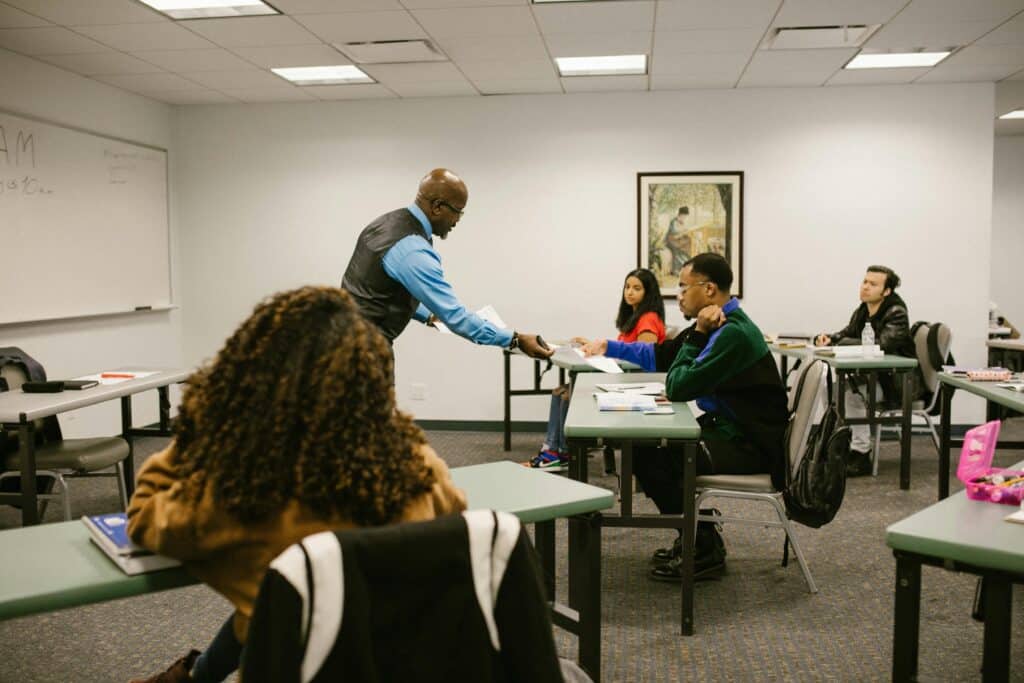
Previously challenging classroom environments transform into vibrant learning spaces when phones disappear. Teachers witness unprecedented levels of student participation and genuine academic curiosity.
Engagement improvements include:
• Active participation during entire lesson periods
• Meaningful peer-to-peer discussions and collaboration
• Increased focus on assignments and learning activities
One classroom observation particularly stood out to an educational specialist: “Before, during, and after the lesson, students were actively participating and discussing the material. This level of engagement has been rare lately.”
The teacher attributed this remarkable transformation directly to their strictly enforced phone prohibition policy. This wasn’t an isolated case – similar energy appeared consistently across multiple classrooms with phone bans.
Participation quality changes:
• Students ask more thoughtful questions during instruction
• Peer interactions become more authentic and social
• Assignment completion rates improve significantly
Teachers consistently report that students use class time productively to focus on assignments rather than scrolling through social media or watching videos. The learning environment becomes what educators always envisioned it could be.
The Bottom Line: Phone Bans Work, But Require Strategic Implementation

The evidence is clear: school cellphone bans deliver measurable benefits across academic, social, and behavioral dimensions. Test scores increase by 2-3 percentiles in the second year, while students show improved attendance and reduced chronic absenteeism.
| Outcome Area | Year 1 Results | Year 2 Results |
|---|---|---|
| Test Scores | No significant change | 2-3 percentile increase |
| Suspensions | More than doubled | Returned to pre-ban levels |
| Attendance | Slight improvement | Significant improvement |
| Classroom Management | Initial challenges | Notable improvements |
Success Requires Patience and Planning
The transition period presents real challenges. Suspension rates initially spike as schools enforce new policies, particularly affecting Black students disproportionately. However, these disciplinary issues resolve by year two.
Key benefits emerge gradually:
• Enhanced social interaction and classroom engagement
• Reduced drama and fewer student conflicts
• Improved teacher satisfaction and classroom control
Implementation Matters More Than Policy
School leaders must approach enforcement thoughtfully. Alternatives to suspension – like parent pickup requirements – prove more effective than punitive measures for maintaining attendance.
Schools should expect:
• Initial resistance and enforcement challenges
• Temporary increases in disciplinary referrals
• Long-term gains in academic focus and school climate
The research shows cellphone bans aren’t magic solutions, but they create measurable improvements. Success depends on consistent enforcement and understanding that benefits take time to materialize. For schools considering this policy, prepare for short-term disruption but expect meaningful long-term gains in student engagement and academic performance.
References
King, Daniel L., et al. “’Phones off while school’s on’: Evaluating Problematic Phone Use and the Social, Well‑being, and Academic Effects of Banning Phones in Schools.” Journal of Behavioral Addictions, vol. 13, no. 4, 2024, pp. 913–922. PMC, https://pmc.ncbi.nlm.nih.gov/articles/PMC11737419/
Beland, Louis‑Philippe, and Richard Murphy. “Banning mobile phones in schools improves academic performance.” Newsroom Carleton, 2021. https://newsroom.carleton.ca/story/banning-mobile-phones-schools/
Beland, Louis‑Philippe, and Richard Murphy. “Banning mobile phones in schools can improve students’ academic performance.” Phys.org, 22 Mar. 2021. https://phys.org/news/2021-03-mobile-schools-students-academic.html
“Smartphones at School: A Mixed‑Methods Analysis of Educators’ and Students’ Perspectives on Mobile Phone Use at School.” Education Sciences, vol. 14, no. 4, 2024, article 351. MDPI, https://www.mdpi.com/2227-7102/14/4/351
“To Ban or Not to Ban? A Rapid Review on the Impact of Smartphone Bans in Schools on Social Well‑Being and Academic Performance.” Education Sciences, vol. 14, no. 8, 2024, article 906. MDPI, https://doi.org/10.3390/educsci14080906
“Researchers: We Looked at All the Recent Evidence on Mobile Phone Bans in Schools — This Is What We Found.” Phys.org, 2024. https://phys.org/news/2024-03-evidence-mobile-schools.html
“Mobile Phone Ban in Schools Fails to Enhance Grades or Behavior.” KidsWebNews, 2025. https://www.kidswebnews.com/mobile-phone-ban-in-schools-fails-to-enhance-grades-or-behavior/
“Student Phones, School Bans, and Youth Mental Health.” Cyberbullying Research Center, 2025. https://cyberbullying.org/student-phones-school-bans-youth-mental-health