
Top Tips for Success in Choir: Unlocking Your Full Potential

You rush into choir rehearsal five minutes late, sheet music scattered in your hands, wondering if you’ll ever sound as polished as the singers around you. The director gives you that look – the one that says “we’ve been warming up without you” – and suddenly you’re questioning whether you have what it takes to truly excel in this musical community you’ve grown to love.
Master Essential Vocal Techniques for Choir Excellence
Your voice is your instrument, and like any musician, you need to understand how to play it properly. Breathing from your diaphragm transforms your sound instantly. Instead of shallow chest breathing that leaves you gasping mid-phrase, learn to let your stomach expand naturally as air flows in. Your shoulders shouldn’t move at all.
Key vocal fundamentals that separate good singers from great ones:
• Never sing louder than what sounds beautiful with your natural voice
• Practice proper posture with feet hip-width apart and relaxed knees
• Use lip trills and humming exercises to warm up your voice safely
• Focus on singing to the end of each note and finishing word sounds completely
Master Essential Vocal Techniques for Choir Excellence
Develop Proper Breathing Technique Using Diaphragmatic Breathing

Your breathing forms the foundation of excellent choral singing. Think of your body as the engine that drives your voice and your breath as the fuel. Learning how to get better at choir starts with mastering diaphragmatic breathing rather than shallow chest breathing.
The diaphragm descends into your stomach area when you inhale, pushing down and expanding your ribcage sideways. This creates expansion around your stomach, sides, and back for optimal breath support.
Key breathing skills to develop:
• The ability to inhale large quantities of air for long phrases
• Quick breath-catching between musical phrases
• Controlled breath release for sustained, consistent sound
Practice the Straw Phonation Method
Sit or stand straight with balanced head and square shoulders. Inhale as if sipping through a straw, then exhale immediately. Keep this movement fluid without holding your breath for maximum effectiveness.
Pass out actual drinking straws to experience this technique properly. Knowing how to get better at choir involves consistent practice of these fundamental breathing exercises during warm-ups.
Straw breathing benefits:
• Strengthens lower support muscles naturally
• Ensures consistently low breathing patterns
• Simple yet highly effective for all skill levels
Master Controlled Breath Release Techniques
Your stomach should maintain that full feeling immediately after breathing in. Try holding this position as long as possible while singing to slow your diaphragm’s return to its relaxed position underneath your lungs.
Light a candle and blow gently so the flame flickers but doesn’t extinguish. Keep your stomach in the full-feeling position throughout this exercise for maximum breath control development.
Breath control exercises:
• Hissing exercises for extended exhalation practice
• Candle flame control for steady airflow
• Timed breathing to build endurance and consistency
Maintain Correct Posture for Optimal Vocal Alignment

Stand with feet hip-width apart and weight evenly distributed. Transfer your weight from right to left foot, forward and backward, then find your centered position. Keep knees relaxed and arms resting naturally by your sides.
Avoid raising your chin, which creates unnecessary strain and tension. Good posture enables effective breathing, making how to get better at choir much more achievable through proper body alignment.
Posture essentials:
• Feet firmly planted, shoulders square and balanced
• Head balanced without chin lifting or neck tension
• Relaxed jaw and face to prevent singing interference
Control Your Volume to Blend Harmoniously
Your sternum should remain strong and erect without sagging. Focus on drawing breath low into your body while keeping your upper body relaxed during inhalation. Never suck in your stomach while singing.
Avoid lifting shoulders, clenching hands or jaw, or making noisy gasping sounds when breathing. Understanding how to get better at choir includes learning to blend your voice seamlessly with others.
Volume control tips:
• Practice singing at various dynamic levels while maintaining breath support
• Focus on consistent airflow rather than forced loudness
• Listen actively to balance your voice within the choir section
Practice Vocal Warm-ups and Cool-downs
Start breathing exercises lying down, then progress to sitting upright or standing. For additional challenge, perform these exercises while walking to build coordination and breath control simultaneously.
If you feel light-headed during any breathing exercise, take breaks and return later. These exercises need only be performed for a few minutes at a time for maximum benefit without strain.
Warm-up progression:
• Begin with gentle breathing exercises in comfortable positions
• Gradually increase complexity and duration as skills develop
• Always prioritize relaxation and proper technique over speed or intensity
Maximize Your Rehearsal Preparation and Participation
Learn Your Notes and Lyrics at Home Before Rehearsal

Coming prepared to rehearsal transforms your choir experience dramatically. When you learn your part beforehand, you maximize precious rehearsal time for musical interpretation rather than note-learning. This preparation shows respect for your director and fellow singers while demonstrating your commitment to excellence.
How to get better at choir starts with home practice that includes studying your vocal line, lyrics, and basic rhythms before stepping into the rehearsal room.
Key preparation strategies:
• Study your vocal part using recordings or piano accompaniment
• Memorize lyrics and practice pronunciation of difficult words
• Mark challenging passages in your music for extra attention
Attend Rehearsals Consistently and Arrive on Time
Consistency builds the foundation of successful choir participation. Regular attendance allows you to develop with the group and understand the director’s vision. Arriving on time shows professionalism and ensures you benefit from warm-ups and important announcements that prepare you for productive rehearsal work.
Directors rely on your presence to balance sections and maintain ensemble cohesion throughout the rehearsal process.
Benefits of punctual attendance:
• Participate in warm-ups that prepare your voice and mind
• Receive important musical and logistical information
• Contribute to balanced sectional sound from the beginning
Listen Attentively to Your Music Director’s Instructions
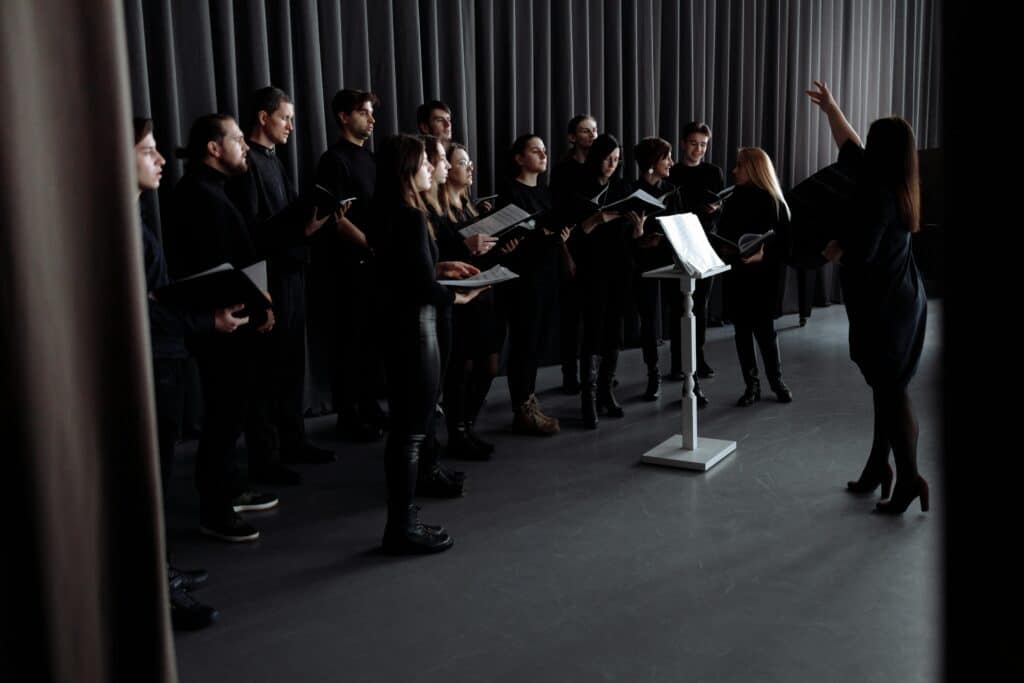
Active listening during rehearsal accelerates your musical growth exponentially. Your director provides specific feedback about tone, phrasing, dynamics, and musical expression that transforms good singing into exceptional performance. Focus completely on their guidance rather than chatting with neighbors or losing concentration.
How to get better at choir involves absorbing every piece of musical wisdom your director shares during rehearsal sessions.
Essential listening practices:
• Maintain eye contact with your director during instructions
• Take mental or written notes about specific corrections
• Apply feedback immediately when singing resumes
Memorize Music Quickly to Improve Group Cohesion
Swift memorization elevates your choir’s collective performance quality significantly. When singers know their parts by heart, they can focus on musical expression, watching the director, and listening to other sections. This creates the unified sound that distinguishes exceptional choirs from average ones.
Memory work also builds confidence and allows for more dynamic, engaging performances that connect deeply with audiences.
Effective memorization techniques:
• Practice away from your music stand regularly
• Use repetition and muscle memory to internalize challenging passages
• Connect lyrics to musical phrases for stronger retention
Explore Your Vocal Range and Artistic Abilities

Your vocal range represents the entire amount of pitches you can produce with your voice. Understanding how to get better at choir starts with safely expanding this range through dedicated practice and proper technique.
Experiment with different vocal styles and techniques
Dynamic control allows you to change your voice volume precisely. Practice articulation exercises to ensure your audience understands beautiful poetry in choir pieces clearly and effectively.
• Master dynamic vocal exercises to control volume without distorting performance quality
• Develop articulation skills for clear lyrical communication during choral performances
Practice using your full vocal range safely
Your vocal cords are muscles requiring gradual development over time. Never strain when reaching difficult notes, as patience prevents injury while expanding your capabilities through consistent practice.
Scale practice forms the foundation of vocal agility. Start with smaller intervals like thirds and fifths, gradually working toward octaves and beyond for precise pitch matching.
• Begin with comfortable pitches and gradually expand without forcing or straining
• Use interval training to develop precise pitch matching and harmonic blending skills
• Practice scales daily to improve smooth, accurate note transitions
Develop your ability to harmonize with others

Interval training helps you sing two notes with specific distances between them. This develops your musical ear while learning how to get better at choir harmonization skills essential for blending.
Working with thirds, fifths, and octaves trains your ability to match pitches precisely. This skill proves crucial for achieving the harmonic blending required in ensemble singing.
• Practice interval exercises starting with smaller distances between notes
• Focus on pitch matching accuracy to blend seamlessly with other choir members
Add vocal color and texture to enhance performance
The vowel “i” provides excellent starting point for range development. Use vertical mouth opening instead of stretching lips sideways for better vocal production and resonance.
Baby noises with “waaa” sounds create beneficial twang quality. Maintain lifted cheeks and dropped jaw while practicing this technique for improved cord closure and clarity.
• Practice Italian vowels (i/e/a/o/u) to develop vocal color and texture variety
• Use lip trill slides over full octaves to safely expand range boundaries
Understanding how to get better at choir involves mastering these vocal textures. The five Italian vowels provide comprehensive exercise coverage for developing expressive singing capabilities.
Use breath control effectively for sustained phrases
Diaphragmatic breathing exercises develop your voice in multiple ways. Increased air capacity provides more power, often removing limiting factors in your vocal range development completely.
Breathing exercises train control over air amount, giving you greater agility. Consistent warm-ups protect your voice while improving range capabilities through proper muscle preparation and conditioning.
• Develop diaphragmatic breathing capacity to increase vocal power and sustained phrase ability
• Complete thorough warm-ups before range exercises to protect voice and improve performance
• Practice breath control exercises daily to maintain consistent air support during long phrases
Learning how to get better at choir requires dedication to returning to these breathing practices consistently. Your voice opens through curiosity and patience, never through force or strain.
Maintain Vocal Health and Prevent Injury

Now that we have covered essential techniques and preparation strategies, protecting your voice becomes paramount for long-term choir success. Your vocal cords are delicate muscle tissues that require careful maintenance to sustain how to get better at choir performance over time.
Take Vocal Rest Breaks During Extended Practice Sessions
Extended rehearsals can strain your vocal cords without proper rest intervals. Schedule regular breaks every 30-45 minutes during practice sessions to allow your voice to recover and prevent overuse injuries that could sideline your progress.
Key rest strategies:
• Take 5-10 minute vocal breaks hourly during rehearsals
• Practice vocal naps similar to rest days in physical workouts
• Allow vocal cords to recuperate between intense singing sessions
Seek Professional Feedback and Vocal Coaching When Needed
Professional guidance helps identify potential vocal issues before they become serious problems. A qualified vocal coach can teach proper breathing techniques, posture alignment, and how to get better at choir singing through personalized instruction tailored to your specific needs.
Professional support benefits:
• Early detection of vocal strain or improper technique
• Personalized assessment and treatment plans for vocal health
• Expert guidance on proper vocal techniques and injury prevention
Practice Good Hygiene to Prevent Illness Spread

Maintaining proper hygiene protects both your voice and fellow choir members from infections that can compromise vocal performance. Simple preventive measures significantly reduce the risk of respiratory illnesses that affect vocal quality and attendance.
Clean hands, covered coughs, and avoiding shared water bottles help maintain choir health standards. Stay home when experiencing symptoms to protect others and allow proper recovery time.
Essential hygiene practices:
• Wash hands frequently and avoid touching your face during rehearsals
• Use personal water bottles and avoid sharing eating utensils or music folders
• Stay home when experiencing cold or flu symptoms to prevent spread
Recognize Warning Signs of Vocal Strain or Damage
Early recognition of vocal problems prevents minor issues from becoming career-threatening conditions. Understanding how to get better at choir performance includes knowing when to rest your voice and seek professional help for persistent symptoms.
Persistent hoarseness, throat pain, or vocal fatigue lasting more than a few days requires professional evaluation. Voice changes, difficulty hitting certain notes, or breathing problems during singing indicate potential vocal cord damage.
Critical warning signs:
• Persistent hoarseness, breathiness, or rough voice quality lasting several days
• Throat pain, vocal fatigue, or difficulty swallowing during or after singing
• Reduced vocal range, strain reaching notes, or sensation of throat tightness
Summary Table
| Key Area | Main Focus | Essential Tips |
|---|---|---|
| Vocal Techniques | Proper breathing, posture, voice control | Breathe low, never sing louder than beautiful, maintain alignment |
| Rehearsal Success | Preparation and participation | Learn notes/words at home, attend regularly, listen to director |
| Vocal Range Development | Exploring capabilities and expression | Practice different styles, use full range, add vocal color |
| Vocal Health | Preventing injury and maintaining voice | Stay hydrated, get sleep, avoid strain, take rest breaks |
Key Takeaways
• Master proper breathing technique by letting air fall naturally into your diaphragm
• Always prioritize beautiful tone over volume in choir singing
• Prepare thoroughly at home by learning notes and lyrics before rehearsal
• Maintain excellent posture with feet hip-width apart and relaxed alignment
• Stay hydrated and get adequate sleep to protect your vocal health
• Attend rehearsals consistently as choir singing is truly a team effort
• Listen more to singers around you than to your own voice
• Practice regularly, even just 10 minutes daily while driving or walking
• Memorize music quickly to connect with audiences and watch your conductor
• Experiment with different vocal styles and techniques to expand your abilities
• Use proper warm-up exercises to prevent vocal strain and build unity
• Focus on telling the story through expressive singing and meaningful lyrics
• Take vocal rest breaks when needed and seek help if hoarseness persists
Your journey as a choir singer requires dedication, preparation, and consistent practice. By focusing on proper vocal techniques, maintaining your health, and fully participating in rehearsals, you’ll unlock your true potential.
Remember that choir singing is a collaborative art form where your individual growth contributes to the collective success. Each rehearsal and performance offers opportunities to develop both technically and artistically.
Are you ready to implement these strategies and transform your choir experience into something truly extraordinary?
References
Brandler, Brian J., and Zehra F. Peynircioglu. “A Comparison of the Efficacy of Individual and Collaborative Music Learning in Ensemble Rehearsals.” Journal of Research in Music Education, DOI: 10.1177/0022429415597885, jrme.sagepub.com Accessed 15 Jan. 2026
Hearn, Elizabeth (Libby) R. “Assessment in the Choral Classroom: A Case Study of a Secondary Choral Program.” International Journal of Research in Choral Singing, vol. 9, 2021, acda.org/wp-content/uploads/2021/09/IJRCSVol9Hearn.pdf Accessed 15 Jan. 2026
Kapsner-Smith, M. R., et al. “A Randomized Controlled Trial of Two Semi-Occluded Vocal Tract Protocols.” PubMed Central, 2015, https://pmc.ncbi.nlm.nih.gov/articles/PMC4610291/ Accessed 15 Jan. 2026
Mount Sinai Health System. “Tips for Caring for Your Voice.” Mount Sinai – Grabscheid Voice & Swallowing Center, https://www.mountsinai.org/locations/grabscheid-voice-swallowing-center/our-services/professional-performance-voice-care/tips Accessed 15 Jan. 2026
National Association of Teachers of Singing (NATS). “Voice Rest.” Journal of Singing / NATS On-Point, 2019, https://www.nats.org/_Library/JOS_On_Point/JOS-075-5-2019-557_-_Voice_Rest_-_Satalof_-_Cline_-_Lyons_-_Skeffington_-_Rubin.pdf Accessed 15 Jan. 2026
Riquelme-Muñoz, C., et al. “Effectiveness of Vocal Exercises in Singers: A Scoping Review.” PubMed / National Library of Medicine, 2024–2025, https://pubmed.ncbi.nlm.nih.gov/41058356/ Accessed 15 Jan. 2026
Titze, Ingo R. “Voice Training and Therapy with a Semi-Occluded Vocal Tract.” PubMed / National Library of Medicine, 2006, https://pubmed.ncbi.nlm.nih.gov/16671856/ Accessed 15 Jan. 2026
Voice Foundation. “Fall 2021 Newsletter: Tools for Your Voice Box.” The Voice Foundation, 2021, https://voicefoundation.org/wp-content/uploads/2021/12/Fall-2021.pdf Accessed 15 Jan. 2026
American Speech-Language-Hearing Association (ASHA). “Voice Training and Therapy (SOVTEs) / Clinical resources.” ASHA Publications, https://pubs.asha.org Accessed 15 Jan. 2026
Clinical Practice Guidelines (Entnet / AAO-HNS). “Hoarseness / Prevention table,” American Academy of Otolaryngology — Head and Neck Surgery, https://www.entnet.org/wp-content/uploads/2021/04/hoarseness_preventiontable_source.pdf Accessed 15 Jan. 2026