The Psychology Behind Why Educational Games Work So Well: Key Principles Explained

Picture this: a group of students, eyes wide, hunched over their tablets or board games, laughing as they race to solve a tricky puzzle. No one’s zoning out. The room buzzes with curiosity and a little friendly competition. That’s the power of educational games—they pull you in, make you intrigued, and suddenly, learning isn’t a chore. It’s a challenge you want to win.
Learning sticks when your actively engaged. Educational games push you to think, try, fail, and you get feedback right away, so those “aha!” moments come faster.
They turn practice into action by weaving choices and consequences into play. You retain skills and actually use them later. You’re not just memorizing for a test; you’re building real-world muscle memory.
You’re also way more motivated when the challenge fits and the stakes feel real. Game-based learning adapts to your level, adds excitement, and gives you some control over your learning. You’re not just along for the ride; you’re steering, and that’s where the magic happens.
Key Takeaways
- Educational play forces active use of knowledge, which strengthens memory.
- Strong mechanics give instant feedback and matched challenge to speed up skill growth.
- Context, choice, and repeat practice help you transfer learning into real-world ability.
| Principle | Impact |
|---|---|
| Active Engagement | Improves retention and recall |
| Immediate Feedback | Speeds up correction and growth |
| Motivation | Keeps learners focused |
Core Psychological Principles of Educational Games
Educational games use smart psychological tricks to make learning stick. You’re not just absorbing info because games make you think, act, and react. They tap into your mind to improve and spark emotion. All of this shapes how well you remember and use what you learn.
Active Engagement and Memory Formation
Active learning forces you to actually use information, not just read it. Games that make you decide, solve, or repeat push your brain to lock in knowledge. When you plan a move, test an idea, or apply a rule, you’re doing the heavy lifting that builds memory.
Designs that demand critical thinking—like branching stories or puzzles—train you to transfer skills. You practice in real contexts, so you can use those skills later. Short, focused tasks that make you recall info work way better than passive lectures.
- Active engagement cements knowledge
- Short, focused tasks beat long passive ones
- Critical thinking tasks help with transfer
| Engagement Type | Learning Benefit |
|---|---|
| Problem Solving | Deepens understanding |
| Recall Practice | Strengthens memory |
Immediate Feedback and Rapid Learning Loops

Instant feedback connects your action to the outcome. When a game tells you right away what worked or bombed, you can fix mistakes while it’s still fresh. That loop makes learning faster and less frustrating.
Good feedback explains why an answer was right or wrong, not just “correct” or “nope.” It points out the mistake, shows the right move, and tosses in a quick example. That way, you actually see where you tripped up.
- Immediate feedback speeds up learning
- Clear explanations help map errors to solutions
- Balanced feedback keeps attention sharp
Intrinsic and Extrinsic Motivation
You show up with your own reasons to learn, but rewards help too. Educational games that support choice, progress, and teamwork tap into your inner drive. Picking your path, tracking improvement, and working with others all boost motivation.
Rewards like badges and leaderboards work if they feel real. If they’re just fluff, they can actually make you care less. Use them to kickstart practice, but keep the spotlight on meaningful challenges and growth.
- Intrinsic motivation comes from real progress
- External rewards should highlight true skill
- Mixing choices and visible progress keeps you engaged
| Motivator | Effect |
|---|---|
| Autonomy | Boosts long-term engagement |
| Badges/Points | Start engagement, guide practice |
The Role of Emotional and Cognitive Engagement
Emotions flag info as important. That rush from winning or the sting of a close loss makes memories stick. Games that spark curiosity or surprise grab your attention, and attention is the front door to learning.
Your brain can only juggle so much. Clear instructions and gradual steps keep you from getting overwhelmed. The less clutter, the more you focus on the real task and actually learn.
- Emotional engagement boosts memory
- Clear design reduces overload
- Balanced challenge keeps you tuned in
Game Mechanics that Drive Learning Success
These game mechanics shape motivation, guide practice, and make progress obvious. Small rewards, visible milestones, and quick feedback that get you to improve and retain info.
Gamification Elements: Points, Badges, and Leaderboards
Points give you instant feedback for what you do right. Award them for correct answers, speed, or creativity—just make the rules clear. If the scoring feels random, trust drops fast.
Badges mark your milestones. Use levels (bronze, silver, gold) to show progress. Give badges names that actually mean something, like “Fraction Solver — Level 2,” so they’re more than just digital stickers.
Leaderboards can fire up competition for some. Offer weekly or group boards so newbies don’t get discouraged. Let people opt out or join smaller groups to keep things friendly.
- Points measure specific actions
- Badges show real progress
- Leaderboards motivate, but can be optional
| Element | Purpose |
|---|---|
| Points | Immediate feedback |
| Badges | Milestone recognition |
| Leaderboards | Competitive motivation |
Progression Systems: Levels, Challenges, and Achievements
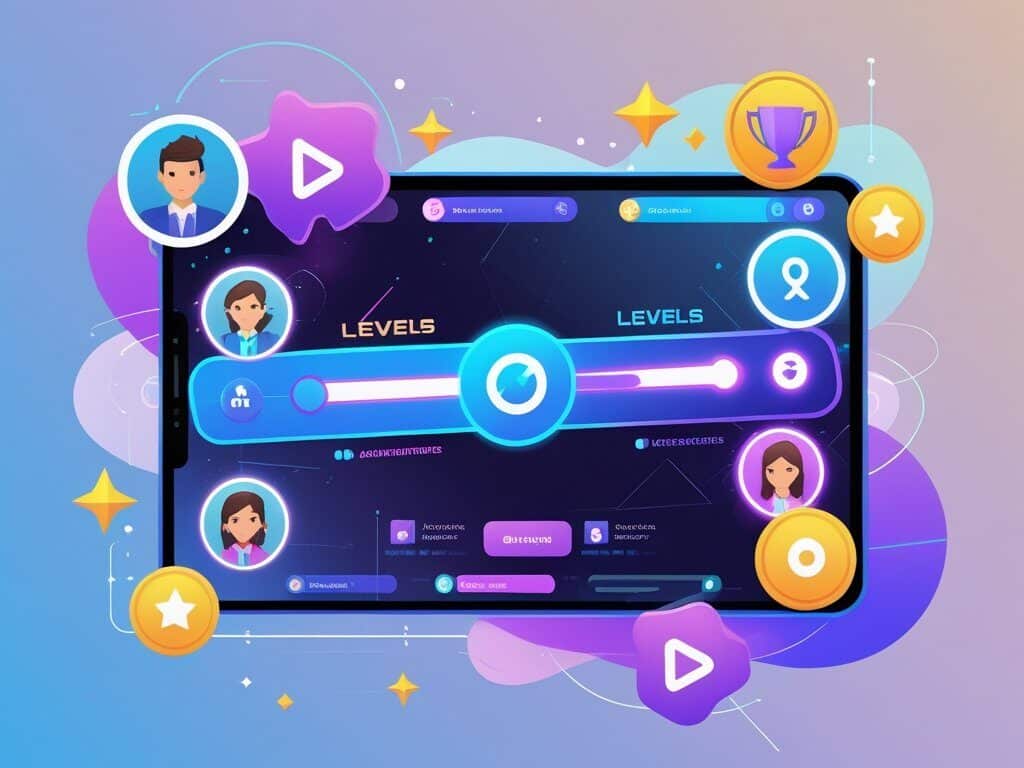
Levels give you a path forward. Each level should be just a bit harder, so you’re always stretching but not snapping. Early levels should be short to build momentum, then grow as you master the basics.
Challenges focus your practice. Mix timed drills, problem sets, and projects. Tag them by skill so you can target what needs work.
Achievements record what you’ve actually done—like “Solved 10 word problems” or “Explained a solution.” Track progress with bars or checklists so you know you’re moving forward.
- Levels structure practice
- Challenges target weak spots
- Achievements show concrete progress
| System | Learning Benefit |
|---|---|
| Levels | Scaffolded growth |
| Challenges | Targeted practice |
| Achievements | Motivation and tracking |
Feedback Mechanisms and Reward Systems
Immediate feedback is key. Say, “Try simplifying the parentheses first,” instead of just “Wrong.” Link feedback to an example or tip so you can fix mistakes right away.
Mix up rewards. Give small, frequent ones (like points) and bigger, rarer ones (badges or new levels). Make sure you’re rewarding the right things—like creative solutions, not just fast guesses.
After a mistake, show a model solution and a quick practice item. That way, every error turns into a learning moment, not just a dead end.
- Feedback should be actionable
- Rewards need to match real learning
- Next steps after mistakes matter
How Educational Games Foster Deeper Learning and Skill Development

Educational games don’t just boost your motivation but they also build real skills and help you tackle tough challenges. Clear Goals, feedback, and practice drive competence. Choices and setbacks shape grit and creativity.
Competence, Autonomy, and Relatedness
Games hit your core needs: competence, autonomy, and relatedness. Clear goals and instant feedback show progress and mastery. When a game breaks skills into small steps, you get lots of practice and less frustration.
Making choices—like which task to tackle—lets you control your pace and plan. That freedom makes you care more. Team missions or co-op play add a social spark, making effort feel shared and worthwhile.
- Competence grows with clear goals
- Autonomy boosts engagement
- Relatedness adds social motivation
| Need | How Games Meet It |
|---|---|
| Competence | Scaffolded tasks, clear feedback |
| Autonomy | Meaningful choices |
| Relatedness | Co-op and team play |
Promoting Problem-Solving and Critical Thinking

Good educational games throw layered problems your way. You plan, test, and tweak strategies. You have to weigh trade-offs—speed versus accuracy, resources versus risk. That’s real-world thinking.
Games create safe places to try ideas and see what happens. Fast feedback lets you adjust and learn. Puzzles that need pattern recognition or systems thinking build mental models you’ll use again—maybe even outside the classroom.
- Problem-solving sharpens with practice
- Safe failure encourages risk-taking
- Reflection turns action into learning
| Skill | Game Example |
|---|---|
| Critical Thinking | Puzzles, branching scenarios |
| Problem-Solving | Strategy games, simulations |
Encouraging Persistence and Growth Mindset
Picture this: you’re stuck on a tough level in a game, maybe failing a few times. But you keep going, right? Games have this sneaky way of making failure feel totally normal—almost expected—as part of the learning process.
Each time you mess up, you get another shot, now armed with a bit more info. That cycle of repeat practice? It’s actually building persistence and planting the seeds of a growth mindset. You start to realize skill isn’t fixed—it’s something you can grow if you stick with it.
- Failure becomes just another step, not a dead end
- Practice and effort take center stage
- Growth mindset naturally develops
| Game Element | Impact on Mindset |
|---|---|
| Repeat Practice | Builds persistence |
| Failure Feedback | Normalizes mistakes |
Reward systems in games aren’t just about winning. Sometimes you get badges for practicing a lot, or you see stats showing how much time you’ve spent improving. It’s not about being perfect—it’s about improvement and effort.
Game designers know how to keep you hooked. They make things harder only after you’ve shown some mastery, which keeps you from feeling overwhelmed or helpless. That’s a clever way to reinforce a growth mindset.
- Progress is measured, not perfection
- Challenges adapt to your skill level
| Reward Type | What It Reinforces |
|---|---|
| Badges | Consistent effort |
| Progress Metrics | Visible growth |
You build persistence by tackling tasks that get more complex over time. It’s not just about grinding alone, either. Sometimes, teaming up with classmates or friends gives you new strategies and some much-needed support.
Honestly, seeing someone else crack a problem can be a game-changer. That social side—collaboration and sharing tips—makes the whole process a bit less intimidating.
- Complexity increases gradually
- Collaboration boosts confidence
After enough practice and a few victories, you don’t just get better at the game—you start carrying a growth mindset into real-life challenges. Isn’t it wild how a simple game can change the way you approach setbacks?
References
Csikszentmihalyi, Mihaly. Flow: The Psychology of Optimal Experience. Harper & Row, 1990, https://www.harpercollins.com/products/flow-mihaly-csikszentmihalyi.
Dweck, Carol S. Mindset: The New Psychology of Success. Random House, 2006, https://www.penguinrandomhouse.com/books/44330/mindset-by-carol-s-dweck-phd/.
Gee, James Paul. What Video Games Have to Teach Us About Learning and Literacy. 2nd ed., Palgrave Macmillan, 2007, https://www.palgrave.com/gp/book/9781403984531.
Hamari, Juho, et al. “Does Gamification Work? A Literature Review of Empirical Studies on Gamification.” 47th Hawaii International Conference on System Sciences, IEEE, 2014, pp. 3025-3034, https://doi.org/10.1109/HICSS.2014.377.
Hattie, John, and Helen Timperley. “The Power of Feedback.” Review of Educational Research, vol. 77, no. 1, 2007, pp. 81-112, https://doi.org/10.3102/003465430298487.
Kapp, Karl M. The Gamification of Learning and Instruction: Game-based Methods and Strategies for Training and Education. Wiley, 2012, https://www.wiley.com/en-us/The+Gamification+of+Learning+and+Instruction-p-9781118096345.
Mayer, Richard E. “Cognitive Theory of Multimedia Learning.” The Cambridge Handbook of Multimedia Learning, edited by Richard E. Mayer, Cambridge University Press, 2005, pp. 31-48, https://doi.org/10.1017/CBO9780511816819.004.
Plass, Jan L., et al. “Emotional Design in Multimedia Learning: Effects of Shape and Color on Affect and Learning.” Learning and Instruction, vol. 29, 2014, pp. 128-140, https://doi.org/10.1016/j.learninstruc.2013.02.006.
—. “Foundations of Game-Based Learning.” Educational Psychologist, vol. 50, no. 4, 2015, pp. 258-283, https://doi.org/10.1080/00461520.2015.1122533.
Roediger, Henry L., and Jeffrey D. Karpicke. “The Power of Testing Memory: Basic Research and Implications for Educational Practice.” Perspectives on Psychological Science, vol. 1, no. 3, 2006, pp. 181-210, https://doi.org/10.1111/j.1745-6916.2006.00012.x.
Ryan, Richard M., and Edward L. Deci. “Intrinsic and Extrinsic Motivations: Classic Definitions and New Directions.” Contemporary Educational Psychology, vol. 25, no. 1, 2000, pp. 54-67, https://doi.org/10.1006/ceps.1999.1020.
—. “Self-Determination Theory and the Facilitation of Intrinsic Motivation, Social Development, and Well-Being.” American Psychologist, vol. 55, no. 1, 2000, pp. 68-78, https://doi.org/10.1037/0003-066X.55.1.68.
Sweller, John. “Cognitive Load Theory.” Psychology of Learning and Motivation, vol. 55, Academic Press, 2011, pp. 37-76, https://doi.org/10.1016/B978-0-12-387691-1.00002-8.
Wouters, Pieter, et al. “A Meta-Analysis of the Cognitive and Motivational Effects of Serious Games.” Journal of Educational Psychology, vol. 105, no. 2, 2013, pp. 249-265, https://doi.org/10.1037/a0031311.
Young, Michael F., et al. “Our Princess Is in Another Castle: A Review of Trends in Serious Gaming for Education.” Review of Educational Research, vol. 82, no. 1, 2012, pp. 61-89, https://doi.org/10.3102/0034654312436980.