How to Avoid Plagiarism in a Research Paper: Easy Fixes
You’re at home, revising your research paper, then you remember your teacher’s strict zero-tolerance policy on plagiarism, and you wonder, “How can I avoid plagiarism in my research paper?”
Learning how to avoid plagiarism in a research paper is one of the most important skills you can learn as a student. Plagiarism is best avoided in your academics and life in general. That’s where this academic article helps.
Here’s what this article will cover:
- What Counts as Plagiarism in a Research Paper
- Use Sources Correctly From the Start
- Cite Evidence Clearly and Consistently
- Common Mistakes and Easy Fixes
- Tools That Help You Check and Prevent Problems
The key is building good habits early: taking clear notes, using your own words, and citing every source you borrow.
If you want more research-based study strategies and academic writing tips like these, ScholarlySphere offers free guides for students at every academic level, from middle school to college.
What Counts as Plagiarism in a Research Paper
Plagiarism means using someone else’s ideas, words, or creative work without giving proper credit. Sometimes it’s intentional, sometimes accidental, but it’s better to avoid both for academic and ethical purposes. According to Indiana University’s Writing Tutorial Services, plagiarism covers a wider range of behaviors than most students realize — from copying full paragraphs to borrowing a single phrase without credit.
Direct, Mosaic, and Self-Plagiarism
Direct plagiarism — the classic. It’s when you copy someone’s exact words and paste them into your paper without quotation marks or a proper citation.
Every academic institution treats this as academic dishonesty because it’s the most blatant form of academic theft.
Mosaic plagiarism — slightly sneakier. This is when you take phrases from a source and blend them into your own wording without proper quotations or citations.
You might swap in some synonyms or use a similar message, but the structure and ideas still belong to the original author. This one’s slightly less blatant than direct plagiarism but is still considered academic dishonesty at most institutions.
Self-plagiarism — the sneakiest. This is when you reuse your own previous work for a new assignment without permission.
The APA Style guidelines point out that submitting a paper written for one class to satisfy an assignment in another may break your school’s academic integrity policy.
Here’s a simple guide to avoid it:
- Ask your instructor first. Get their okay in writing.
- Cite your earlier paper as a source if they allow it.
- Rewrite and expand instead of copying and pasting.
Before you use your old work, ask for permission from your teacher. Even though it’s the least obvious form of plagiarism, it’s not worth the risk it brings.
Accidental and Unintentional Misuse of Sources

Unintentional plagiarism is the least obvious. It might be a missing citation after paraphrasing, or you take sloppy notes and later mistake a source’s words for your own.
According to Harvard’s guide to using sources, the consequences of accidental plagiarism can be just as serious as intentional plagiarism. Either way, the results are better to be avoided.
The fix? Stay organized. Label your notes clearly, and always record where each idea in your research paper comes from.
Common Knowledge vs. Ideas That Need Credit
Not everything needs a citation. Common knowledge — like “water freezes at 32°F” or “the Earth orbits the Sun” — doesn’t require a source.
Here’s a quick guide for what requires citations:
| Needs a Citation | Does Not Need a Citation |
|---|---|
| A specific statistic or data point | Widely known facts (e.g., water boils at 100°C) |
| An author’s original argument or theory | Your own original analysis or conclusions |
| A direct quote from any source | General historical dates (e.g., WWII ended in 1945) |
| A paraphrased idea from a book or article | Dictionary-level definitions of common words |
| Statistics, survey results, or research findings | Proverbs, idioms, or widely shared cultural knowledge |
If you’re unsure, just cite it. The University of Arizona Libraries says the only things you don’t need to cite are common knowledge and your own original ideas. So, even if you didn’t perfectly track your research notes, adding citations is always the safer move.
Use Sources Correctly From the Start
Strong academic writing depends on what you do during research, not only while writing your final draft. Factor in your research habits early, and you’ll be surprised by what you catch before it becomes a problem.
Take Research Notes That Separate Your Ideas From Source Material
To avoid plagiarism from the start, begin by writing down research notes for every source you read. This means every time you read a source, jot down the author, title, page number, and URL right away.
Try a simple two-column method:
- Left column: Direct quotes or paraphrased points from the source, with page numbers.
- Right column: Your own thoughts, reactions, or questions about the material.
This way, you’ll always know which ideas are yours and which belong to someone else. Make sure your notes are organized and clearly sourced before moving forward.
The University of Pennsylvania’s library guide also points out that giving yourself enough research time makes it less tempting to rely too heavily on just one or two sources.
Done right, research notes don’t just protect you from plagiarism — they strengthen your paper’s overall credibility.
Choose When to Quote, Paraphrase, or Summarize
Each method has its own place in your research paper. Here’s a simple guide:
- Quote when the exact wording matters. Use quotation marks around the author’s words and include an in-text citation.
- Paraphrase when you want to restate an idea in your own words. Change both the sentence structure and the vocabulary, then cite the source.
- Summarize when you need to condense a large section or an entire article into a few sentences. Still cite the source.
Common mistake: changing only a word or two and calling it a paraphrase. That’s actually mosaic plagiarism, which can lead to academic dishonesty.
Instead of this:
“The consequences of plagiarism are much more serious than turning in a paper late.” (original)
“The consequences of plagiarism are way more serious than submitting a paper late.” (too close)
Try this:
According to Harvard’s guide, the problems caused by copying someone else’s work are far worse than any penalty for a late submission.
Build Original Analysis Into Your Draft
Have this mentality: sources shouldn’t be your main argument — they’re only there to support it. The goal is to use sources as evidence to back up your own argument.
After each quote or paraphrase, add a sentence or two explaining why that evidence matters. What does it prove? How does it connect to your thesis?
This helps you avoid surface-level explanations and adds your original thought to the paper.
A literature review section, for example, should show how different studies relate to each other and to your research question.
Quick tip: Peer review — having another person read your work and flag any sections that feel underdeveloped — is one of the best ways to catch surface-level writing before your instructor does.
Cite Evidence Clearly and Consistently
Proper citation is the backbone of ethical academic writing. In-text citations, reference lists, and correct formatting all work together to protect your paper from plagiarism.
How In-Text Citations Work
In-text citations appear right after you use a source’s idea, data, or words. They signal to the reader that the information comes from an external source, which can be found in the reference page or bibliography at the end of your paper.
Here’s a quick reference for in-text citation format by style:
| Style | In-Text Citation Example | Where to Learn More |
|---|---|---|
| APA | (Smith, 2024, p. 12) | APA Style Official Guide |
| MLA | (Smith 12) | Purdue OWL — MLA |
| Chicago (Notes) | Superscript number linked to a footnote | Chicago Manual of Style |
Put the citation right after the borrowed material, usually before the period at the end of the sentence. Every paraphrase, summary, and direct quote needs one.
Quick tip: Use Control-F to search your draft for quotation marks. Every time you find one, make sure an in-text citation follows it immediately.
Reference List, Bibliography, and Endnotes
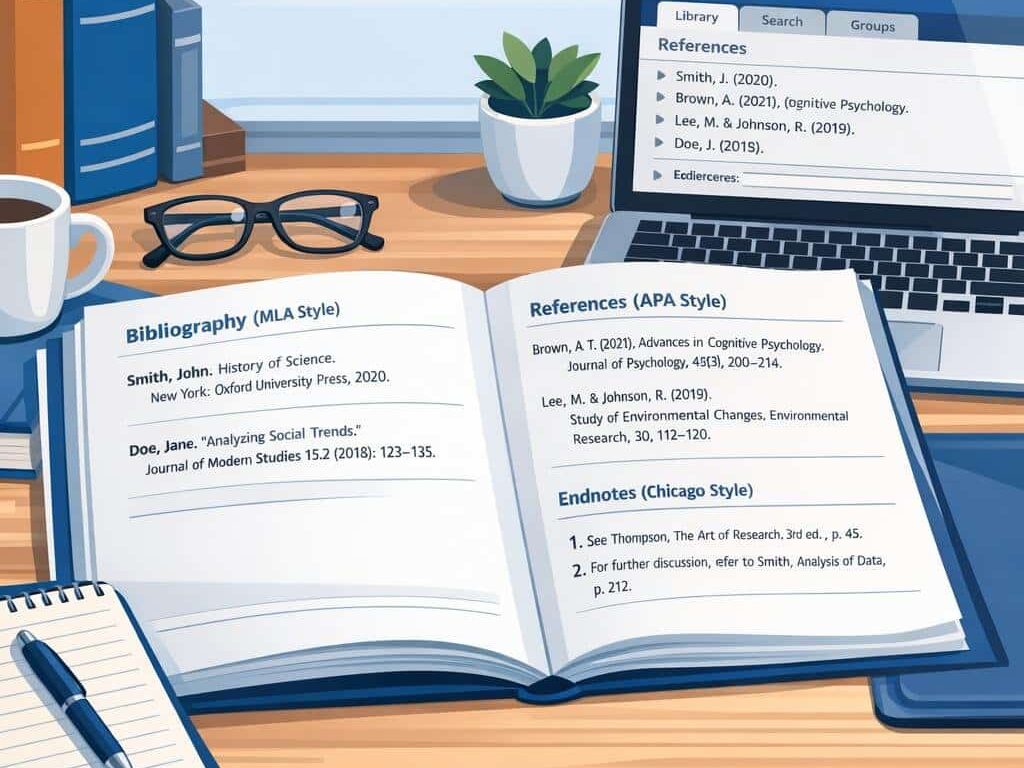
Your reference list (APA), works cited page (MLA), or bibliography (Chicago) goes at the end of your paper. It includes the full details for every source you cited.
Key things to include for each entry:
- Author name(s)
- Publication date
- Title of the work
- Publisher or journal name
- URL or DOI (for online sources)
Endnotes work similarly but are collected at the end of the document instead of at the bottom of each page. Tools like EndNote make it easier to manage big reference lists, especially for longer research papers.
Every in-text citation needs a matching entry in your reference list. If it doesn’t, your citation is incomplete — and that’s a direct risk for academic dishonesty.
Follow MLA, APA, or Other Citation Rules Carefully
Your instructor will usually tell you which citation style to use in your research paper. Each style has its own rules for citations, titles, dates, and page numbers.
Common citation rules to follow:
- Use quotation marks around any exact phrase you borrow, even if it’s only a few words.
- Include page numbers for direct quotes when the style requires them.
- Be consistent. Don’t mix APA and MLA citation rules in the same paper.
- Double-check formatting against your style guide. The Purdue OWL is a solid, free reference for both MLA and APA citation rules.
For further help with citation credibility and formatting rules, we offer a free guide here on ScholarlySphere.
Common Mistakes and Easy Fixes
Most students, after following all these steps, will still allow something to slip through the cracks. Many easy things lead to plagiarism, but they also have easy fixes.
Patchwriting and Weak Paraphrasing
Patchwriting is when you change the wording of a phrase but keep the same overall skeleton or sentence structure as the original.
Most instructors call this plagiarism, even if you didn’t mean it. Better safe than sorry.
Paraphrasing well isn’t always easy, but here’s a process that works for a lot of people:
- Read the original passage.
- Close the source.
- Write the idea from memory, using your own words.
- Open the source again and compare — make sure your version really looks and sounds different.
- Add your citation.
If you just can’t restate the idea without keeping the same sentence skeleton, use a direct quote, cite it, and add your own analysis after.
Missing Citation After a Paraphrase or Quote

Forgetting to add a citation after a paraphrase or quote is probably one of the most common slip-ups in research paper writing.
You paraphrase or quote someone, get distracted, and the citation never appears.
The fix is pretty simple: every time you finish a sentence with borrowed information, add the citation right away — don’t wait until later.
Tip: Drop in placeholder tags like “[CITE]” while drafting, then come back during the revision stage and fill them in.
Stony Brook University’s citation resource recommends this exact approach so nothing sneaks by. By building these simple habits, you’ll learn how to ethically use external resources throughout your academic career.
Tools That Help You Check and Prevent Problems
Establishing these anti-plagiarism habits is important, but many tools can speed up the process and be just as effective on their own.
When to Use a Plagiarism Checker
Run a plagiarism checker after your final draft, during the revision stage.
These tools scan your text against databases of published work, websites, and other papers to flag matching phrases.
Some popular options include:
- Turnitin: Most universities use it already, so you might not have a choice.
- Grammarly: Has a plagiarism checker alongside grammar suggestions.
- Scribbr: Built for academic writing, powered by Turnitin’s database.
- Quetext: A student-friendly option with a free tier.
None of these guarantee your paper is spotless, but they serve as a great guide to keeping your research paper plagiarism-free.
They flag text matches, but can’t tell if your paraphrasing is too close or if your citation format is right, so always proofread manually as well.
Citation Generators and Reference Managers
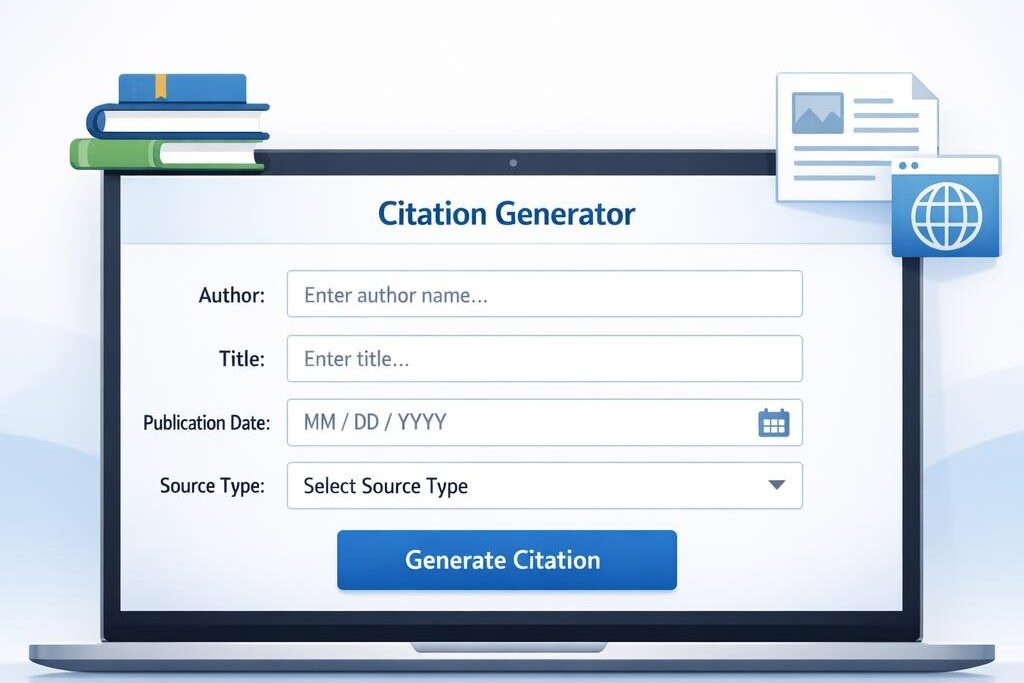
Formatting citations by hand is tedious and easy to mess up. This is where citation generators and reference managers come in.
Here are some notable options:
- Citation generators (like Google Scholar’s built-in tool or the Scribbr citation tool) generate formatted entries when you input a title, URL, or DOI.
- Reference managers like EndNote or Zotero keep all your sources in one place and can insert formatted citations as you write.
Don’t trust these tools blindly, though. Always double-check against your reference style guide — sometimes they miss edition numbers or format dates incorrectly.
Using AI Writing Tools Responsibly
Let’s be clear: AI tools are not supposed to write your paper for you. If you use an AI tool to generate text and submit it as your own work, most schools consider that plagiarism — and it can lead to serious academic consequences.
According to plagiarism detection resources, many modern checkers used by teachers now flag AI-generated content alongside regular text matches.
So, how can you use AI responsibly?
- Use it for brainstorming or organizing your ideas — don’t let it write your final paragraphs.
- When you get suggestions from AI, rewrite them in your own voice.
- Double-check your school’s policy on AI before getting too comfortable with any tool.
- If your instructor asks for it, go ahead and cite the AI tool you used.
Final Thoughts: How to Avoid Plagiarism in a Research Paper
Plagiarism is one of those things that sneaks up on you when you’re rushing. A missing citation here, a paraphrase that stayed too close there, and suddenly you’re facing assumptions of academic dishonesty.
More than anything, remember that your own analysis is what makes a research paper worth reading. Sources are evidence — they back up your argument, not replace it. When your voice drives the paper and your citations are clean, you don’t have to stress.
That’s the goal. Write something that’s actually yours.
Works Cited
“Anti-Plagiarism Checklist.” Compilatio, https://www.compilatio.net/en/blog/anti-plagiarism-checklist
“Avoid Plagiarism.” Stony Brook University Libraries, https://guides.library.stonybrook.edu/citations/avoid-plagiarism
“Citation Practices.” University of Pennsylvania Libraries, https://guides.library.upenn.edu/citationpractices/strategies
“5 Most Effective Methods for Avoiding Plagiarism.” Grammarly Blog, https://www.grammarly.com/blog/plagiarism/5-most-effective-methods-for-avoiding-plagiarism
“How to Avoid Plagiarism.” Harvard College Writing Program — Using Sources, President and Fellows of Harvard College, https://usingsources.fas.harvard.edu/how-avoid-plagiarism
“Mosaic Plagiarism.” Scribbr, https://www.scribbr.com/plagiarism/mosaic-plagiarism/
“Plagiarism.” APA Style, American Psychological Association, https://apastyle.apa.org/style-grammar-guidelines/citations/plagiarism
“Plagiarism.” University of Arizona Libraries, https://lib.arizona.edu/research/sources/plagiarism
“Plagiarism: What It Is and How to Recognize and Avoid It.” Writing Tutorial Services, Indiana University, https://wts.indiana.edu/writing-guides/plagiarism.html
“Purdue OWL: Avoiding Plagiarism.” Purdue Online Writing Lab, Purdue University, https://owl.purdue.edu/owl/avoiding_plagiarism/index.html
“Recognizing and Avoiding Plagiarism in Your Research Paper.” Quetext Blog, https://www.quetext.com/blog/recognizing-avoiding-plagiarism-in-your-research-paper
“A Student’s Guide to Avoiding Plagiarism with AI Checkers.” Sourcely, https://www.sourcely.net/resources/a-students-guide-to-avoiding-plagiarism-with-ai-checkers
“What Is Self-Plagiarism?” Scribbr, https://www.scribbr.com/plagiarism/self-plagiarism/
“What Is Plagiarism?” Merriam-Webster, Merriam-Webster Inc., https://www.merriam-webster.com/dictionary/plagiarism
“Why Citations Matter.” MIT Academic Integrity, Massachusetts Institute of Technology, https://integrity.mit.edu/handbook/citing-your-sources/why-citations-matter
“Zotero: Your Personal Research Assistant.” Zotero, Corporation for Digital Scholarship, https://www.zotero.org