How to Write a Research Paper: A Step-by-Step Guide

It’s midnight, you’re starting to come up with a research paper outline for your class, and then you wonder, “What actual steps are put into writing a good research paper?”
Knowing how to write a research paper is a skill you’ll use over your academic life and beyond. Whether you’re in high school or college, these assignments appear in almost every subject, so learning how to make them well is a valuable skill.
Here’s what this article will cover how to:
- Understand the Assignment and Set a Plan
- Choose a Focused Topic and Build Research Questions
- Develop a Clear Thesis and Working Outline
- Write the Opening and Closing Sections
- Use Citations and References Correctly
- Edit, Revise, and Finalize Your Draft
You’ll find practical “instead of this, do this” tips, examples, and checklists along the way. If you want more support, ScholarlySphere has free, research-based articles on academic writing, study habits, and exam prep you can check out anytime.
Understand the Assignment and Set a Plan
Before you even begin writing, make sure you know exactly what your instructor wants. Whether it be the paper structure, citation style, and scope of your argument, these all depend mostly on the assignment instructions.
What Your Instructor Is Really Asking For
When reading the assignment prompt, read it more than once. Check for these key things:
- Length: How many pages or words?
- Topic freedom: Are you picking the topic, or is it assigned?
- Source requirements: How many sources? What types?
- Citation style: APA, MLA, Chicago?
- Due date: When’s it due? Any checkpoints before the final?
If you find anything unclear, clarify with your professor until you have a complete understanding.
According to a step-by-step research writing plan from the State University of New York at Potsdam, one of the biggest problems students face when writing a research paper is not completely understanding the assignment instructions.
How to Break the Project Into Manageable Tasks
Don’t treat a research paper as one big assignment. Think of it as many steps leading to a completely revised final draft, each with its own mini-deadlines.
Here’s a basic breakdown and example timeline:
| Task | Example Timeline |
|---|---|
| Read and clarify assignment | Day 1 |
| Choose and narrow topic | Days 2–3 |
| Take notes and conduct research | Days 4–7 |
| Build outline and thesis | Day 8 |
| Write first draft | Days 9–12 |
| Revise and edit | Days 13–14 |
| Final proofread and submit | Day 15 |
Adjust accordingly to your assignment due date. Even a rough schedule helps with time management and keeps you on pace to finish either before or at the due date, preventing lost points from turning it in late.
Using Notion or a Simple Tracker to Stay Organized
Notion is great for tracking research sources, drafting notes, and deadlines all in one app. But if you can’t get the app, a plain notebook and Google Doc can do most, if not everything, Notion can do.
Here’s how to do it:
Write things down instead of trying to remember. As you find research sources, jot down important details — URL, page number, or more — just enough so you won’t have to go back into your search history.
Choose a Focused Topic and Build Research Questions
When picking a topic, don’t only factor in your own interests. You’ll need to come up with something focused enough to make an effective argument, backed by credible sources, and framed around a clear research question.
How to Narrow a Broad Subject
Most students start with a very broad subject. “Climate change” is a subject, not a topic.
To improve your subject, narrow it down to something you can actually analyze or argue in your paper — into an actual research topic.
Here’s a simple example to funnel down your topic:
- Broad subject: Climate change
- Narrower area: Effects of climate change on agriculture
- Focused topic: How rising temperatures affect corn yields in the Midwest
With a focused research topic, your paper will have a clear direction. As the University of Guelph Library research guide puts it, moving from a broad topic to a specific problem is how you get a workable research question.
How to Conduct Preliminary Research

Before you finalize your topic, do a quick round of preliminary research.
Look for:
- Recent articles or studies on the subject
- Key debates or disagreements in the field
- Gaps in existing research you could address
Check your school library databases, Google Scholar, or government and university websites. When evaluating research sources, the Harvard Guide to Using Sources suggests checking the author’s credentials, where it’s published, and how in-depth it goes.
This way your essay will be credible to your teacher and more appealing to your audience, which can lead to a better grade — especially if your teacher has specific grading criteria for credibility.
As always, don’t use Wikipedia as a main source. Instead, use it to find sources and get the background information needed to build a basic understanding of your topic.
How to Turn Ideas Into Strong Research Questions
A strong research question is specific, arguable, and answerable with evidence.
Here’s an example:
- Too vague: Does social media affect teens?
- Stronger: How does daily Instagram use affect body image in adolescent girls aged 13–17?
Research.com’s guide on writing research questions recommends starting with a broad topic and then narrowing in by identifying a specific problem or gap. This research question will later guide your thesis statement.
Develop a Clear Thesis and Working Outline
Your thesis statement and paper outline are what convert your research into an actual paper. The thesis lays out your central argument, and the outline maps how it will be proven or addressed.
How to Develop a Thesis Statement
The thesis is a one or two-sentence statement that lays out your stance or central argument. It should be specific, debatable, and supportable with evidence.
Here’s an example of a good thesis statement:
- Weak: Social media has effects on teenagers.
- Strong: Daily use of Instagram contributes to increased body image dissatisfaction among teenage girls by promoting unrealistic appearance standards.
The strong version takes a clear stance and signals what the paper will argue.
According to a research paper thesis guide from collegeessay.org, your thesis should appear near the end of your introduction and set up the path for the rest of your research paper.
Also, don’t worry about your thesis changing over the course of writing. It’s a normal occurrence when you encounter more information.
What Strong Topic Sentences Do
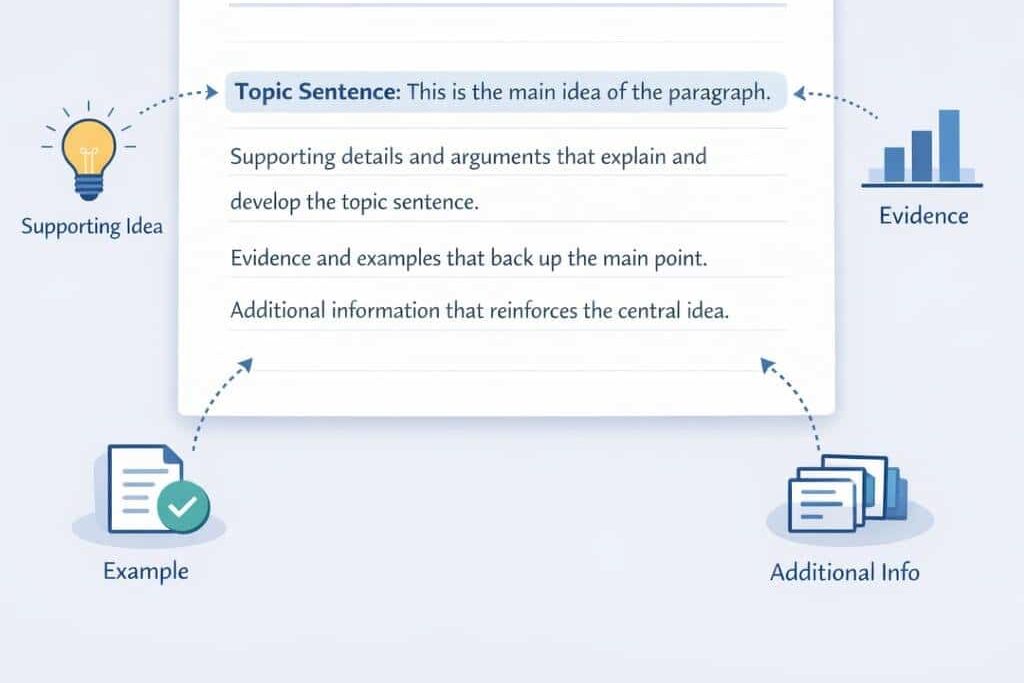
Every body paragraph needs a topic sentence that ties directly back to your thesis. Think of topic sentences as mini-arguments supporting your overall research argument.
Here’s an example of a topic sentence:
- Weak topic sentence: Instagram is popular with teenagers.
- Strong topic sentence: Research shows that frequent exposure to filtered images on Instagram lowers self-esteem among girls aged 13–17.
The strong version actually advances your argument while supporting your thesis. It doesn’t act as a general statement.
How to Map the Paper Before Drafting
Your outline doesn’t have to be perfect. It just needs to give you a logical order to follow.
Here’s a basic structure effective for most research papers:
- Introduction and thesis
- Background or context
- Main argument or point 1
- Main argument or point 2
- Main argument or point 3
- Counterargument and rebuttal (if needed)
- Conclusion
Grammarly’s research paper outline guide notes that outlining helps you spot weak areas in your argument and organize your ideas before spending time drafting.
Write the Opening and Closing Sections
Your introduction, abstract, title page, and conclusion are what readers see first and last. Each one has a specific job when it comes to showing your readers why your research paper argument matters.
How to Write the Introduction
A strong research paper introduction has five elements, as outlined in Scribbr’s step-by-step introduction guide:
- Hook the reader with a fact, question, or statement
- Provide background on the topic
- Establish the research problem you’re addressing
- State your objective or research question
- Map the paper with a brief overview of what’s coming
As an example:
- Instead of this: “This paper will talk about social media and teenagers.”
- Do this: “Studies show a sharp rise in body image issues among teenage girls since the growth of visual social media platforms. This paper examines how daily Instagram use contributes to that trend.”
The second version hooks the reader and sets up the argument. It sounds more relatable and applicable.
How to Create a Strong Abstract and Title Page
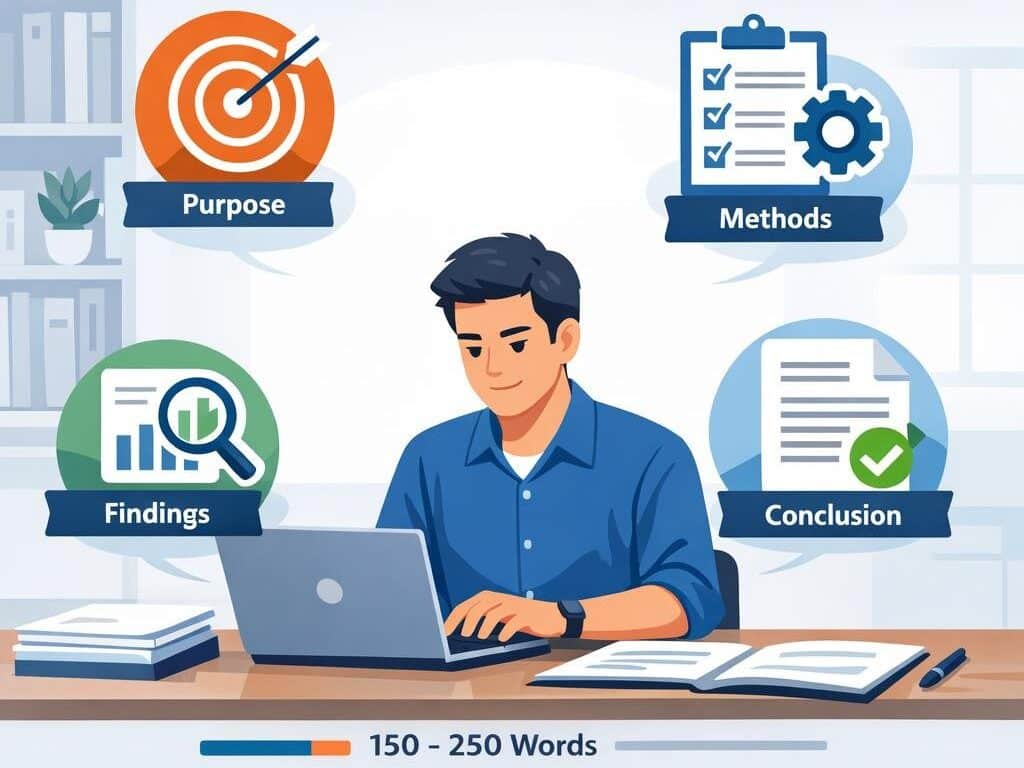
Not every research paper needs an abstract, but plenty of college assignments ask for one — especially when working in APA format.
An abstract is a short paragraph, usually around 150 to 250 words, that sums up your paper’s purpose, methods, findings, and conclusion.
Your title page usually includes:
- Paper title
- Your name
- Course name and number
- Instructor’s name
- Date
Check your assignment guidelines before creating one. APA and MLA handle title pages differently, so double-check this as well.
How to End With a Focused Conclusion
For an effective, memorable conclusion, start by restating your thesis in new words and summing up the main points discussed in your paper.
Then explain why your findings matter — without adding new information. Use what you’ve already established.
End with a strong final sentence that leaves the reader with a new perspective, maybe a call to action or a real-world takeaway.
Use Citations and References Correctly
Citations aren’t optional in the research paper process. You’ll not only need to cite but also know how to do it correctly according to your subject, and how to keep track of them as you go.
Choosing the Right Citation Style
These are the three most commonly used citation styles in U.S. colleges:
| Style | Common Disciplines | In-Text Format |
|---|---|---|
| APA | Psychology, education, social sciences | Author, year: (Smith, 2022) |
| MLA | Literature, arts, humanities | Author, page: (Smith 45) |
| Chicago | History, some humanities | Footnotes or author-date |
If your instructor doesn’t specify a style, just ask. It may seem frustrating, but using the wrong format can cost you points, even if the rest of your research paper is great.
How to Cite Sources Consistently

Cite every time you quote, paraphrase, or summarize someone else’s work. That is your number one rule when it comes to citations.
As Scribbr’s citing sources guide points out, not citing — even if you don’t copy the exact words — still counts as plagiarism. So whenever you use someone else’s work, it’s better to just cite it.
Keep a running list of every source as you research. This way your citations will stay organized rather than scrambling last minute to fill in your references page later. Tools like Zotero or MyBib can automatically format citations for you as you go.
Edit, Revise, and Finalize Your Draft
Now that you have your rough draft, it’s time to revise. Most students skip this out of laziness, but if you do it, your paper will have a better chance of scoring higher and leaving a lasting impact. You might even catch a grammatical error or two.
How to Edit and Revise for Clarity
During your revision stage, ask yourself: Does your argument make sense throughout your entire paper? Is your thesis supported all the way through? Are your paragraphs in an order that actually works for your research topic?
Editing digs into the fine details — word choice, grammar, punctuation, and clarity. Stick to this rule: revise first, then edit.
Otherwise, you’ll be editing sentences that you would’ve cut in the revision process anyway.
The UNC Writing Center says revision literally means “to see again.” When revising your research paper, keep in mind that you’re giving your argument a fresh look — not just proofreading.
A Simple Revision Process Before Submission
Here’s a simple revision process you can use right now:
- Read your full draft out loud. Weird or awkward sentences jump out fast.
- Check each paragraph — does it actually support your thesis?
- Look for weak topic sentences. If a topic sentence just states a fact, make it do more work for your argument.
- Cut anything off-topic. If a sentence or paragraph doesn’t help your paper, ditch it.
- Check transitions between paragraphs. Each section should flow into the next, at least somewhat logically.
Final Checks for Flow, Format, and Evidence
After revising, use this checklist before submitting:
- Make sure your thesis stands out in the introduction
- Each body paragraph should kick off with a solid topic sentence
- Cite every source both in-text and on the references page
- Stick to one citation style all the way through
- Double-check that your title page and abstract fit the assignment
- Hunt down stray grammar or spelling mistakes
- Make sure page numbers, margins, and font match the required format
The IIT Academic and Research Writing guide points out that revision and editing are where you sharpen your ideas and arguments.
If you can give yourself even a single day between writing and revising, you’ll probably notice your paper getting better and scoring higher.
FAQ
Conclusion: How to Write a Research Paper

Remember that midnight panic from the intro? That’s exactly what this guide was built to fix.
I used this exact process when working on my own research projects, including a paper on childhood obesity. Breaking it up into these steps made it feel easier than just winging it and hoping for the best.
If you want to keep building your academic writing skills, ScholarlySphere has free guides on writing a strong thesis, mastering research skills, and crafting topic sentences that actually work. Use them.
Now close this tab and go write that paper.
References
State University of New York at Potsdam. “6 Simple Steps for Writing a Research Paper.” College Writing Center, https://www.potsdam.edu/sites/default/files/documents/support/tutoring/cwc/6-Simple-Steps-for-Writing-a-Research-Paper.pdf University of Wisconsin–Madison Writing Center. “Planning and Researching Your Paper.” The Writer’s Handbook, https://writing.wisc.edu/handbook/assignments/planresearchpaper/ University of Guelph Library. “Develop a Research Question.” Research Guides, https://guides.lib.uoguelph.ca/c.php?g=743978&p=5379960 Harvard College Writing Program. “Evaluating Sources.” Using Sources at Harvard, https://usingsources.fas.harvard.edu/evaluating-sources-0 Research.com. “How to Write a Research Question.” Research.com, https://research.com/research/how-to-write-a-research-question CollegeEssay.org. “How to Write a Research Paper Thesis.” CollegeEssay.org Blog, https://collegeessay.org/blog/how-to-write-a-research-paper/research-paper-thesis Grammarly. “How to Write a Research Paper Outline.” Grammarly Blog, https://www.grammarly.com/blog/academic-writing/research-paper-outline/ Scribbr. “How to Write a Research Paper Introduction.” Scribbr, https://www.scribbr.com/research-paper/research-paper-introduction/ Scribbr. “Citing Sources.” Scribbr, https://www.scribbr.com/category/citing-sources/ Purdue Online Writing Lab. “Research and Citation Resources.” Purdue OWL, https://owl.purdue.edu/owl/research_and_citation/resources.html UNC Writing Center. “Revising Drafts.” University of North Carolina at Chapel Hill, https://writingcenter.unc.edu/tips-and-tools/revising-drafts Illinois Institute of Technology. “Academic and Research Writing.” Galvin Library Research Guides, https://guides.library.iit.edu/c.php?g=1409228&p=10436130 Pears, Richard, and Graham Shields. Cite Them Right: The Essential Referencing Guide. 11th ed., Bloomsbury Academic, 2019.